
Commercial Air Quality Sensors for Safer, Smarter Facilities
Commercial air quality sensors help schools, manufacturers, hospitality properties, and secure facilities detect vaping, track humidity, monitor indoor air quality, and connect environmental events to alarm, surveillance, and response workflows. Umbrella Security Systems designs integrated solutions that turn environmental data into faster action, clearer documentation, and stronger protection for people, property, and critical operations.
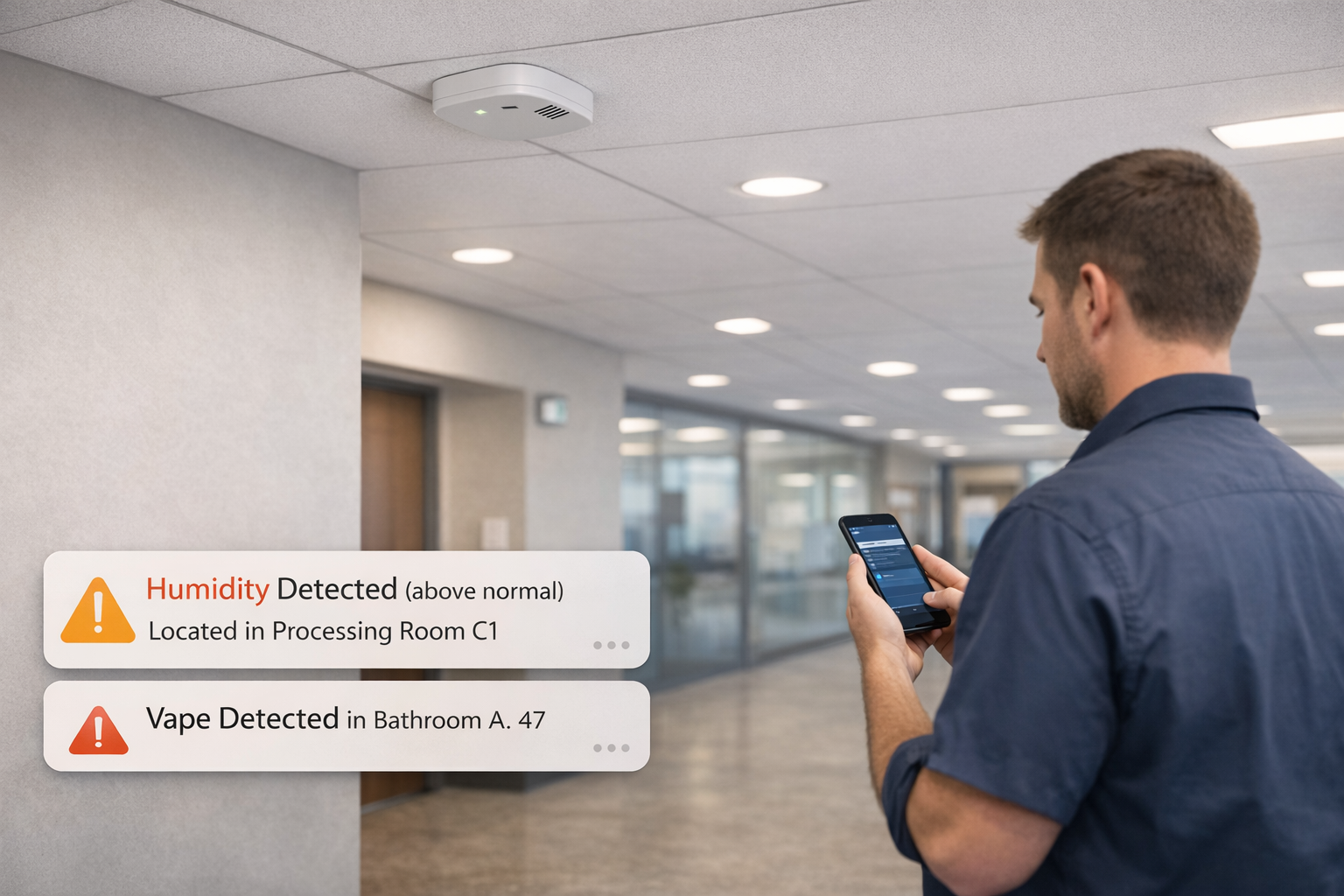
- Privacy-safe coverage for bathrooms, locker rooms, hallways, equipment rooms, and production environments.
- Integrated monitoring for schools, manufacturing facilities, hospitality properties, government buildings, and commercial sites.
- Designed by a systems integrator that understands alarm, surveillance, environmental alerts, and response coordination.
Why Commercial Air Quality Sensors Belong in a Modern Security Strategy
Many organizations still separate environmental monitoring from security. In practice, the risks overlap. Vaping in school restrooms, unstable humidity around sensitive infrastructure, poor air quality in occupied spaces, and hidden environmental issues in manufacturing or hospitality settings all affect safety, uptime, policy enforcement, and response speed.

A standalone sensor can generate a reading. An integrated system can generate action. When commercial air quality sensors are tied into alarm platforms, surveillance systems, notifications, and facility response workflows, teams gain a more useful way to verify events, document activity, protect assets, and respond faster.
That matters in schools where privacy-sensitive areas still need visibility. It matters in manufacturing environments where humidity, ventilation, and product stability can directly affect operations. It matters in hospitality properties and government facilities where environmental conditions shape comfort, compliance, risk, and trust.
Umbrella Security Systems approaches this category as part of a broader integration strategy. The goal is not to install another disconnected device. The goal is to connect environmental awareness to the systems and workflows your team already relies on.
What this page covers
- Vape detection in privacy-sensitive areas
- Humidity monitoring for critical rooms and stored assets
- Indoor air quality monitoring for occupied spaces
- Alarm, surveillance, mobile, and workflow integration
- Practical deployment guidance for schools, manufacturing, hospitality, and secure facilities
From bathrooms and locker rooms to production spaces and equipment rooms, commercial air quality sensors can extend visibility where traditional monitoring alone is not enough.
What Commercial Air Quality Sensors Can Detect
The strongest solutions combine multiple readings in one platform so facilities can monitor environmental conditions, investigate incidents, and trigger response without relying on fragmented tools.
Vape & Smoke Detection
Vape detection sensors help schools, hospitality properties, and other privacy-sensitive environments detect e-cigarette aerosol, smoking activity, and related events where cameras are not appropriate.
Humidity & Temperature
Humidity monitoring sensors matter in equipment rooms, storage areas, manufacturing environments, and food production settings where environmental drift can affect infrastructure, stored materials, or product stability.
VOC, CO2 & Particulate Data
Indoor air quality monitoring can help identify poor ventilation, contamination concerns, or recurring comfort issues in classrooms, conference rooms, hospitality spaces, and occupied commercial environments.
Sound & Disturbance Detection
Some sensor platforms extend beyond air quality into sound and aggression-related monitoring, which can support incident awareness in schools and commercial facilities when paired with surrounding surveillance and alarm workflows.
Mobile & Event Alerts
The real value comes when threshold breaches and sensor events generate actionable alerts for administrators, facilities teams, or security staff instead of sitting inside a disconnected dashboard.
Connected Workflows
Commercial air quality sensors become more valuable when they support surveillance context, alarm workflows, reporting, and building-response coordination.
How Air Quality Monitoring Integrates with Alarm, Surveillance, and Response
Commercial air quality sensors are most effective when they tie into the systems your team already uses. That can include mobile alerts, commercial alarm workflows, video verification, reporting, and building operations.
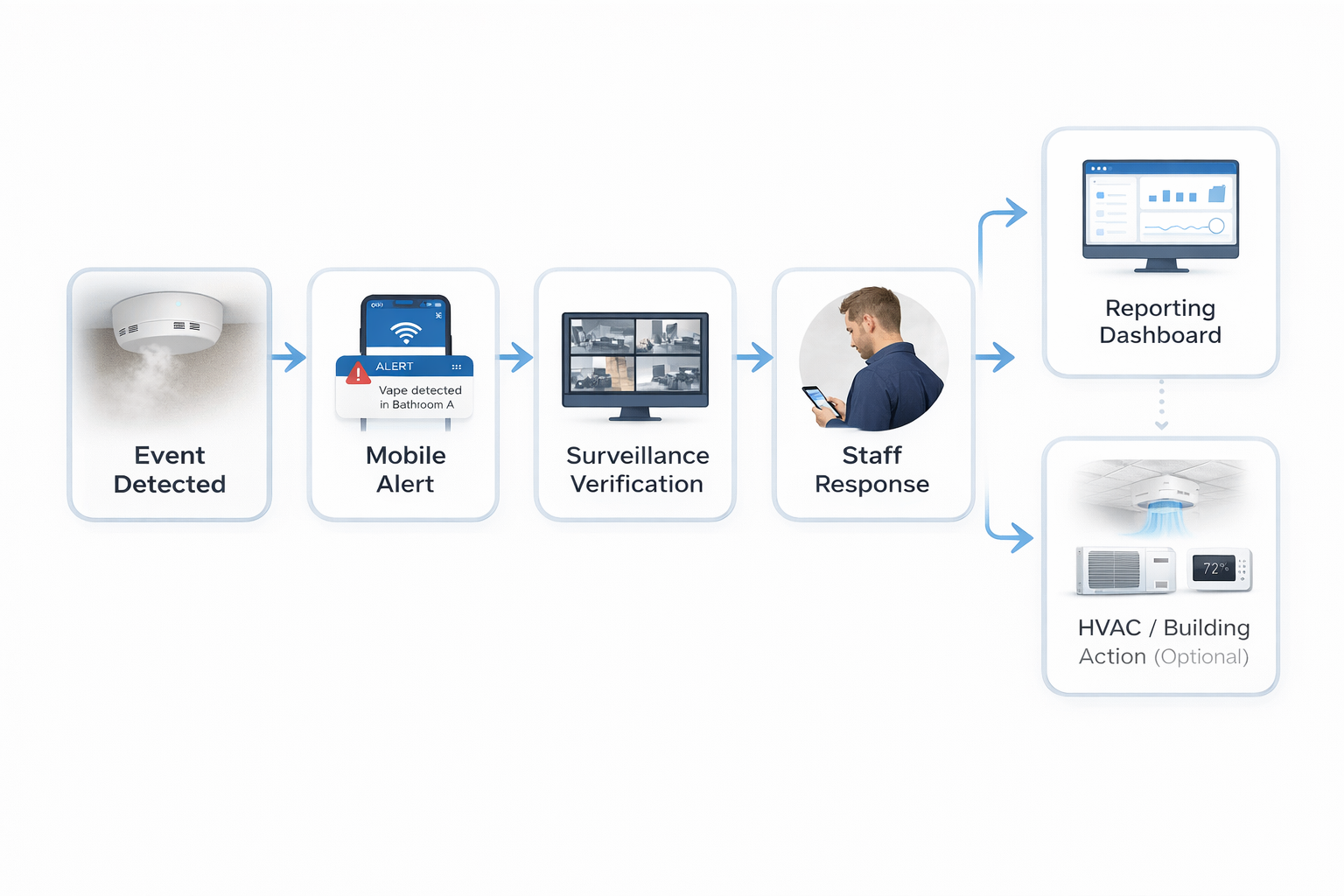
Environmental sensors become more valuable when they trigger alerts, verification, response, and documentation across existing systems.
What integration looks like in practice
Instead of simply showing a humidity reading or vape event in isolation, a well-designed deployment can trigger a mobile alert, direct staff to surrounding video coverage, support follow-up inside the alarm ecosystem, and document the event for operations or policy enforcement.
That is where commercial air quality sensors become part of a larger facility strategy instead of another silo. Schools, manufacturers, and commercial sites all benefit from tighter coordination between environmental alerts, security workflows, and operational action.
For customers evaluating device ecosystems, the Axis air quality sensor is one relevant benchmark because it combines indoor environmental monitoring with vaping and smoking detection in one privacy-conscious platform.
Sensor detects a vape event, humidity shift, or indoor air quality issue.
System sends a mobile alert to administrators, security, or facilities staff.
Nearby surveillance or surrounding context is reviewed when needed.
Staff responds based on policy, maintenance, or operational priority.
Event history supports reporting, repeat-incident tracking, and future tuning.
Real-time alerting in privacy-sensitive spaces
Bathrooms, locker rooms, secluded hallways, break spaces, and equipment rooms often sit outside traditional camera coverage or require a more privacy-aware approach. That is where integrated environmental sensors add operational value.
With the right design, schools and commercial facilities can use alerts to trigger response, speed up review, and support better incident documentation without compromising privacy where it matters most.

Real-time alerts help administrators and security teams respond quickly to vape detection events in privacy-sensitive spaces.
Built for Schools, Manufacturing, Hospitality, and Secure Commercial Facilities
Commercial air quality sensors are not one-size-fits-all. The right deployment depends on the risks in each environment, the systems already in place, and the actions that should follow when a threshold is crossed.

Schools and Education
Schools are one of the clearest use cases for commercial air quality sensors because administrators need to address vaping, air quality, and behavioral concerns in privacy-sensitive areas without placing cameras where they do not belong. Vape detection sensors can support faster intervention, cleaner documentation, and better visibility into repeat hotspots.
Combined with alarms, surrounding video coverage, and mobile alerts, these systems give schools a more practical way to protect students, support policy enforcement, and strengthen response workflows.

Manufacturing and Food Production
In manufacturing and food production environments, humidity monitoring sensors and indoor air quality monitoring can protect product stability, support environmental consistency, and reduce risk around sensitive processes or stored commodities. Nielsen-Massey’s experience with humidity monitoring for vanilla extraction is a strong real-world example of how this extends beyond security into operational protection.
Umbrella’s manufacturing security solutions, combined with environmental sensing, create a stronger framework for protecting facilities, people, infrastructure, and valuable materials.
Hospitality & Commercial Properties
Hospitality environments and commercial facilities can use air quality monitoring, vape detection, and humidity alerts to protect guest spaces, shared areas, equipment rooms, and comfort-sensitive environments. These systems support faster troubleshooting, smoking-policy enforcement, and stronger facility oversight.
Government & Secure Facilities
Government buildings and secure facilities often need a balanced approach to privacy, documentation, and operational visibility. Integrated air quality monitoring can support public-facing spaces, administrative areas, equipment rooms, and other locations where environmental awareness improves readiness and response.
Trusted by Leading Educational Institutions
Umbrella works with school districts and education environments that need integrated security and facility-awareness solutions.













Centralized monitoring software makes it easier to review events, identify trends, and manage sensor activity across facilities.
Vape Detection Sensors in Schools: An Open-Platform Approach for System Integrators
For schools, vape detection sensors are no longer viewed as a standalone product category. They are part of a larger campus safety strategy that must work in privacy-sensitive areas, integrate with existing systems, and scale across multiple buildings and campuses.
School districts are not just looking for a sensor that can detect vaping in bathrooms, locker rooms, and other camera-restricted spaces. They are looking for a solution that fits into their broader security, safety, and facilities environment without creating another disconnected point product. The real value is not just in detection. It is in how the system communicates, automates, and supports response workflows across the district.
Why schools need more than a standalone vape detector
Vaping incidents often happen in areas where traditional video surveillance cannot be used. That makes vape detection an important layer in school safety programs. But once an alert is generated, schools need more than notification alone. They need context, escalation paths, documentation, and integration into the systems they already use.
A disconnected sensor may generate an alert, but an open-platform vape detection strategy allows schools to do more with that event. Alerts can be routed into the video management system, shared with access control workflows, escalated through mass notification platforms, or used to trigger operational actions and incident reporting.
Why open-platform architecture matters in K-12
Most K-12 environments are not standardized around one vendor. Districts often have a mix of VMS platforms, access control systems, intercoms, building automation tools, and notification technologies spread across schools and campuses. A closed system creates friction in these environments. An open system creates flexibility.
What districts should look for
- API-based integrations
- Event sharing across third-party systems
- Flexible alert routing
- Standards-based network deployment
- Long-term interoperability as district technology evolves
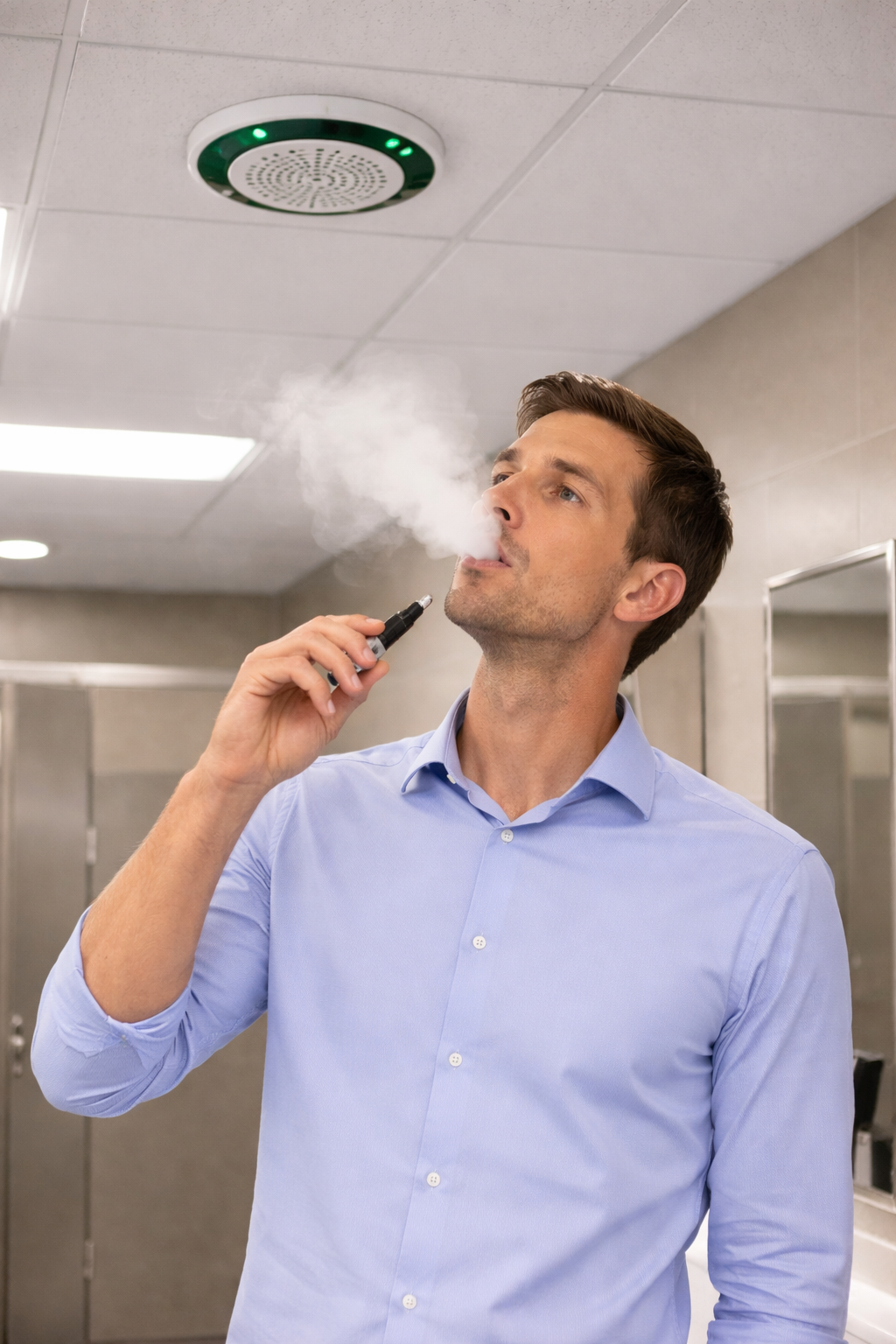
An open-platform approach helps school districts add vape detection to a broader campus safety strategy without creating another silo.
The system integrator advantage
Integrators are in the best position to help schools think beyond hardware. Successful deployments depend on more than sensor placement. They require proper design, network planning, calibration, alert thresholds, workflow mapping, and cross-system integration.
Schools do not benefit from a flood of alarms. They benefit from actionable events delivered to the right staff, in the right format, at the right time.
Build a safer school environment without creating another silo
The best vape detection sensor for schools is not simply the one that detects an incident. It is the one that helps the entire safety ecosystem respond. An open-platform approach gives districts privacy-area protection today while preserving flexibility for tomorrow.
Start with the platform, not just the device
Looking to add vape detection to a broader school safety strategy? Start with an open-platform solution that integrates with the systems your district already uses and the workflows your teams already trust.
Nielsen-Massey Case Study: Humidity Monitoring That Protects a Costly Commodity
Commercial air quality sensors are not only about security incidents. In the right environment, they protect production quality, stored value, and operational decision-making.

Click to play the Nielsen-Massey case study video.
“It’s really to help monitor our extraction beans. So, it kind of alerts us if our humidity drops or rises. We need to do something with the beans. We need to either move them or move them to a different facility. It’s a very costly commodity for us, so we’re really looking to try to protect it.”– Nielsen-Massey case study transcript provided by Umbrella
What Umbrella provided
Umbrella provided access control, video monitoring, alarm security, and humidity sensors. For Nielsen-Massey, that meant humidity tracking became part of a broader protection strategy, helping the team safeguard valuable extraction beans and make faster operational decisions when conditions changed.
Business problem
Humidity changes could affect a costly stored commodity used in production, creating risk beyond traditional security concerns.
Integrated solution
Umbrella combined access control, video monitoring, alarm security, and humidity monitoring in one broader protection strategy.
Operational outcome
The customer gained alerts that support faster environmental decisions, including moving materials when humidity conditions change.
What to Look for in Commercial Air Quality Sensors
The right platform is not just the one with the longest spec sheet. It is the one that fits your environment, integrates cleanly, and helps your team act on what it detects.
Multi-sensor visibility
Look for solutions that combine vaping, smoke, humidity, temperature, and indoor air quality data where that mix supports the use case.
Privacy-safe deployment
Schools, hospitality, and public-facing facilities need solutions that extend awareness without creating unnecessary privacy concerns.
Useful alerting
Thresholds and notifications should be tuned for action, not noise.
Alarm and app compatibility
Environmental alerts become more useful when they connect to commercial alarm workflows and mobile visibility.
Reporting and trend review
Historical data helps diagnose recurring issues, validate policy enforcement, and support long-term decision-making.
Integrator support
Device selection, placement, configuration, and workflow design all matter. That is where an experienced security integrator adds real value.
Humidity deserves more attention than most teams give it
Humidity monitoring is often overlooked until it starts affecting equipment, stored materials, operational stability, or comfort complaints. For customers evaluating commercial air quality sensors, that is one reason a broader environmental strategy often outperforms a single-purpose deployment.
In equipment rooms, network closets, controlled storage areas, and production environments, stable environmental conditions protect the infrastructure and materials your business depends on every day.

Humidity monitoring protects the infrastructure that security, IT, and facility operations depend on every day.
Frequently Asked Questions
What do commercial air quality sensors detect?
Depending on the device, commercial air quality sensors can detect vaping or smoking activity, humidity, temperature, VOCs, carbon dioxide, particulate matter, and other indoor environmental conditions. Some platforms also extend into sound detection and behavioral awareness.
Can air quality sensors be used in school bathrooms and other privacy-sensitive spaces?
Yes. Vape detection and related sensor solutions are often used in privacy-sensitive areas where cameras are not appropriate, especially in schools and similar environments.
How do humidity monitoring sensors help manufacturers?
Humidity monitoring sensors can help manufacturers protect stored materials, stabilize environmental conditions, support product quality, and respond faster when readings move outside acceptable thresholds.
Can these sensors integrate with alarm and surveillance systems?
Yes, depending on the platform and deployment design. Environmental monitoring becomes more useful when alerts are surfaced through alarm workflows, mobile apps, surveillance context, and reporting processes.
Are commercial air quality sensors only useful for vape detection?
No. Vape detection is one strong use case, but many organizations also need humidity monitoring, indoor air quality monitoring, temperature alerts, VOC tracking, and broader environmental awareness tied to operations and facility protection.
Talk to Umbrella About Commercial Air Quality Sensors
If you are evaluating commercial air quality sensors for schools, manufacturing, hospitality, or other secure facilities, the next step is a site-specific conversation. Umbrella can help you design a solution that fits your environment, your workflows, and the systems you already use.