
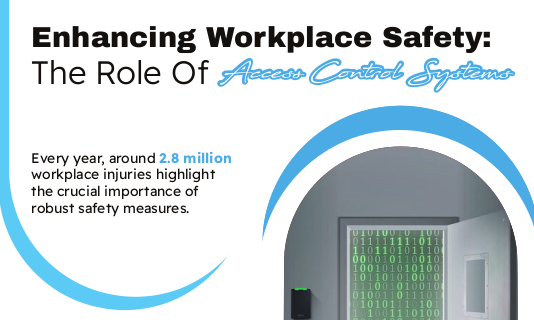
Access control systems stand out as essential tools in strengthening workplace safety, providing various solutions to reduce risks and enhance protection.
Why Access Control Systems Are Critical for Workplace Safety
Every year, millions of workplace injuries and security incidents occur that stricter access management could prevent. Beyond physical injuries, unauthorized access to sensitive areas exposes businesses to theft, data breaches, liability, and regulatory violations. Access control systems address these risks directly — not by adding friction to everyday operations, but by ensuring the right people can get where they need to go, and everyone else can’t.
Modern access control goes well beyond a lock and a key. Today’s systems integrate with video surveillance, alarm systems, identity management platforms, and even HR software to create a security posture that’s both proactive and audit-ready. For commercial facilities of any size, it’s one of the highest-impact investments in workplace safety available.
Limiting Unauthorized Access
The most fundamental function of an access control system is controlling who can enter a space — and who can’t. In a workplace environment, this means defining clear boundaries between public areas, employee-only zones, and restricted areas like server rooms, executive offices, pharmaceutical storage, or equipment bays.
Traditional lock-and-key systems fail at this for a simple reason: keys can be copied, lost, or passed along without any record. A terminated employee who kept a copy of their key represents an ongoing security risk with no easy remedy. Access control systems eliminate this problem entirely.
With key card access systems, mobile credentials, or biometric readers, access rights are tied to an individual identity — not a physical object. When an employee leaves, their access is revoked instantly from a central platform, effective immediately across every door in the facility. No lock changes, no uncertainty.
Beyond entry management, access control systems allow granular permission structures. A warehouse employee might have access to loading docks and break rooms but not the finance department. A contractor gets temporary access to a specific floor for a specific date range, then it expires automatically. This level of control significantly reduces the attack surface for both internal and external threats.
Tracking and Monitoring Movement
Modern access control systems do more than lock and unlock doors — they track every entry and exit with a timestamped log tied to an individual credential. This creates a complete audit trail of who was where and when, which has significant value across multiple scenarios.
Internal Investigations
When an incident occurs — theft, a safety violation, an HR complaint — access logs provide objective data that can confirm or rule out who was present in a given area at a given time. This accelerates investigations and removes the ambiguity that makes workplace incidents difficult to resolve. Paired with commercial security cameras, you get both the access record and the video footage to match.
Compliance and Liability
Many industries have strict regulatory requirements around who can access certain areas — healthcare facilities under HIPAA, financial institutions, pharmaceutical companies, and government contractors all face specific access control mandates. A modern system generates the documentation needed to demonstrate compliance during audits, and provides the records necessary to defend against liability claims if an incident occurs.
Real-Time Occupancy Awareness
Access logs also enable real-time visibility into occupancy — useful for everything from space utilization analysis to emergency mustering. Knowing exactly who has badged into a building is critical when you need to account for all employees during an evacuation. Some systems integrate directly with mass notification platforms to cross-reference who’s on-site when an emergency alert goes out.
Emergency Preparedness and Response
Access control systems play a direct role in how well a facility handles emergencies — from lockdowns to evacuations to after-hours incidents.
Lockdown Capability
In an active threat situation, the ability to lock down an entire facility — or specific zones — from a single command is a critical life-safety function. Modern access control platforms allow security administrators to trigger a facility-wide lockdown instantly, locking all controlled doors simultaneously without requiring anyone to physically secure each entry point. This can be the difference between containing a threat and allowing it to spread.
Controlled Evacuation
Conversely, emergency egress requirements mean that the same doors that restrict access under normal conditions need to release immediately during a fire or other evacuation event. Access control systems integrate with fire alarm panels to automatically unlock all egress doors when an alarm is triggered, ensuring compliance with life-safety codes while maintaining security under normal operations.
Integration with Emergency Notification
When access control is integrated with an emergency mass notification system, your response becomes coordinated rather than chaotic. An access event — like a door forced open in a restricted area after hours — can automatically trigger a camera to record, send an alert to security personnel, and initiate a notification sequence, all without requiring a human to notice and respond to each individual event.
After-Hours Security
Most workplace security incidents don’t happen during business hours. Access control systems with time-based restrictions automatically tighten security after hours — doors that are freely accessible during the day require credential authentication at night. Any access outside of normal hours generates an alert, giving security teams visibility into after-hours activity without requiring round-the-clock staffing.
Choosing the Right Access Control System for Your Facility
The right system depends on your facility’s size, risk profile, and existing infrastructure. Key decisions include:
- Credential type: Key cards and fobs are cost-effective and widely used. Mobile credentials (smartphone-based) are increasingly popular for their convenience and the elimination of physical card management. Biometric systems offer the highest security for sensitive areas but carry higher costs and specific compliance considerations.
- Cloud vs. on-premise: Cloud-based systems offer remote management, automatic updates, and easier scalability — particularly valuable for multi-location businesses. On-premise systems give you full data control and can work without internet connectivity.
- Integration requirements: If you’re planning to integrate with cameras, alarms, HR systems, or notification platforms, make sure the system you choose supports open APIs or has native integrations with your existing tools.
- Scalability: Choose a system that can grow with your facility. Adding doors, locations, or users should be straightforward, not a forklift upgrade.
The best starting point is a professional security assessment that maps your specific access points, identifies vulnerabilities in your current setup, and recommends a system designed around your actual needs rather than a generic spec.
Frequently Asked Questions
What is an access control system?
An access control system is a security solution that manages and restricts who can enter specific areas of a facility. It replaces or supplements traditional locks with electronic credentials — key cards, mobile devices, PIN codes, or biometrics — and maintains a log of all access events. Modern systems can be managed remotely and integrated with other security platforms.
How does access control improve workplace safety?
Access control improves workplace safety by preventing unauthorized individuals from entering sensitive or hazardous areas, creating an audit trail for investigations, enabling rapid lockdowns during emergencies, and automating after-hours security restrictions. It removes the human error and physical limitations of traditional lock-and-key systems.
Can access control integrate with security cameras?
Yes — most modern access control platforms integrate with video management systems, allowing access events to automatically trigger camera recording or pull up the relevant camera feed. This means a door access event is automatically paired with footage from that location, streamlining both monitoring and post-incident review.
What happens to access when an employee leaves?
With an access control system, an employee’s credentials can be deactivated instantly from the central management platform the moment they leave the company. This is one of the most significant security advantages over physical keys, which may be copied, forgotten, or not returned. Some systems integrate directly with HR platforms to automate this process as part of offboarding.
Is access control required by law for certain businesses?
Yes — certain industries have regulatory requirements that mandate specific access controls. Healthcare facilities must comply with HIPAA requirements around access to patient data and medication storage. Financial institutions, government contractors, and pharmaceutical companies face their own specific mandates. Beyond compliance, many commercial insurance policies offer reduced premiums for facilities with documented access control systems in place.