
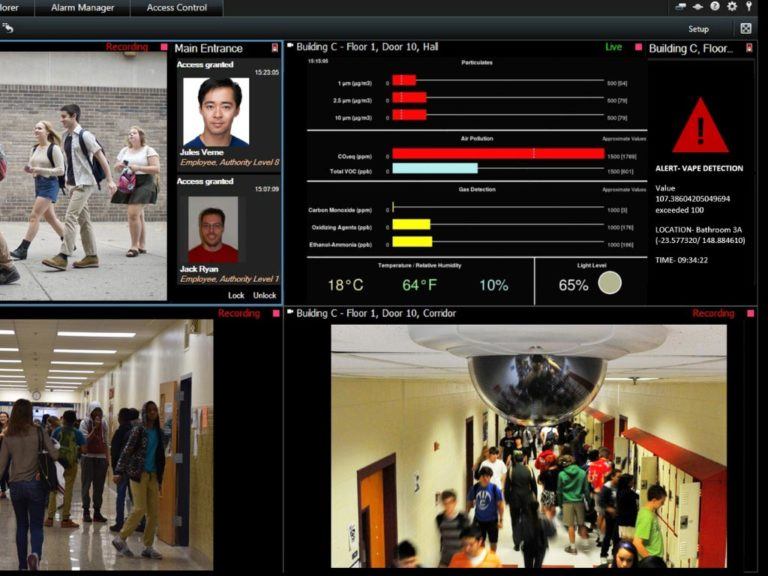
Commercial motion sensors are a foundational component of business security — but “motion sensor” covers a wide range of technologies with meaningfully different capabilities, detection ranges, and appropriate use cases. Choosing the wrong type for a given environment leads to missed detections, excessive false alarms, or both. This guide covers the main types of commercial motion sensors, how they work, and where each performs best.
Why Commercial Motion Sensors Matter for Business Security
Motion detection serves two primary functions in a commercial security system: triggering alerts during intrusion events and activating other security responses — camera recording, lighting, alarms, and notifications. According to the Cybersecurity and Infrastructure Security Agency (CISA), layered detection — combining perimeter detection with interior motion sensors — is the standard framework for effective commercial facility protection.
A well-designed commercial alarm system integrates motion sensors with access control, cameras, and notification systems so that a detection event triggers a coordinated response — not just a beep.
7 Types of Commercial Motion Sensors for Business Security
1. Passive Infrared (PIR) Sensors
PIR sensors are the most widely deployed motion sensors in commercial environments. They detect changes in infrared radiation — body heat — within their field of view. When a warm body moves through the detection zone, the sensor triggers.
Best for: Interior spaces — offices, corridors, storage rooms, server rooms. PIR sensors are reliable, cost-effective, and easy to install, making them the default choice for most interior commercial applications.
Limitations: PIR sensors require line-of-sight detection and can be triggered by heat sources other than people (HVAC vents, direct sunlight). They’re not ideal for outdoor use without weatherproofing and careful placement to avoid environmental false alarms.
2. Microwave Sensors
Microwave sensors emit continuous microwave pulses and detect changes in the reflected signal caused by movement. Unlike PIR sensors, they can detect movement through walls and non-metallic materials.
Best for: Large open spaces like warehouses, manufacturing floors, and areas where complete coverage around corners or through partitions is needed. Also effective in environments with significant temperature variation where PIR performance degrades.
Limitations: More expensive than PIR and more susceptible to false alarms from external sources like passing vehicles or HVAC equipment vibration. Coverage area tuning is important to prevent detecting activity outside the intended zone.
3. Dual-Technology (Dual-Tech) Sensors
Dual-tech sensors combine two detection technologies — typically PIR and microwave — and only trigger when both detect motion simultaneously. This significantly reduces false alarm rates compared to single-technology sensors.
Best for: High-traffic facilities, retail environments, and any application where false alarm reduction is a priority. Also effective in challenging environments where temperature variation, air movement, or vibration would cause single-technology sensors to false alarm frequently.
Limitations: Higher cost than single-technology sensors. The dual-detection requirement means they may miss slow-moving intruders who trigger one technology but not the other — coverage pattern design matters.
4. Ultrasonic Sensors
Ultrasonic sensors emit high-frequency sound waves and detect changes in the reflected pattern caused by movement. They cover areas comprehensively, including around obstacles, because sound waves wrap around objects.
Best for: Spaces with irregular layouts, areas with lots of equipment or shelving, and applications where coverage around obstacles is needed. Effective in environments where PIR line-of-sight limitations are problematic.
Limitations: Sensitive to air turbulence from HVAC systems, which can cause false alarms. Less common in commercial security than PIR or dual-tech and generally higher cost.
5. Area Reflective Sensors
Area reflective sensors emit infrared light and measure the distance to detected objects by analyzing the reflected signal. They create a detection zone defined by distance rather than a wide cone, making coverage highly configurable.
Best for: Applications requiring precise, adjustable detection zones — protecting specific equipment or assets, monitoring entry points where you want to detect presence at a specific distance, or retail loss prevention applications.
Limitations: More specialized and higher cost than standard PIR sensors. Requires careful setup to define the correct detection zone and avoid false alarms from stationary objects.
6. Vibration Sensors
Vibration sensors detect physical vibration or shock — not movement through space — making them fundamentally different from the other sensor types. They’re used to detect tampering, forced entry, or impact on protected surfaces.
Best for: Protecting ATMs, safes, display cases, server racks, and other high-value assets from physical attack. Also used on doors, windows, and walls to detect glass break, forced entry attempts, or structural intrusion.
Limitations: Must be tuned carefully to distinguish between security-relevant vibration and normal environmental vibration (foot traffic, nearby equipment). Sensitivity settings are critical — too sensitive causes false alarms, too insensitive misses events.
7. Tomographic Motion Detection
Tomographic sensors create a mesh network of radio waves between multiple sensor nodes and detect disruption to the mesh caused by movement — including movement through walls and obstacles. Coverage is defined by the sensor node placement rather than line-of-sight.
Best for: Large facilities requiring perimeter detection through walls, outdoor applications where traditional sensors struggle, and high-security environments needing detection that can’t be defeated by moving slowly or avoiding sensor sight lines.
Limitations: Significantly higher cost and installation complexity than other sensor types. Best suited to high-security applications where the capability justifies the investment.
Integrating Motion Sensors with Your Commercial Security System
Motion sensors deliver their full value when integrated with the rest of your security infrastructure rather than operating as standalone devices. In a properly designed system:
- A motion detection event triggers the nearest security camera to begin recording and pulls up the live feed for monitoring
- After-hours detections trigger immediate alerts to on-call security personnel via mass notification systems
- Motion in a restricted area during business hours can be configured to trigger an access control review rather than a full alarm
- Sensor events are logged with timestamps, creating an audit trail for investigations
Motion sensor placement is as important as sensor selection. Coverage zones should be mapped against your facility layout to eliminate blind spots, minimize false alarm sources, and ensure every entry point and high-value area is covered. This is the work of a professional security assessment — not a spec sheet.
Motion Sensors for Specific Commercial Environments
Different industries have distinct motion sensor requirements based on their facility type, operating hours, and risk profile:
- Manufacturing and warehouses: Large open spaces favor microwave or dual-tech sensors with wide coverage range; vibration sensors on high-value equipment and entry points. See our guide to manufacturing security systems.
- Healthcare facilities: PIR sensors in corridors and restricted areas; dual-tech in larger clinical spaces; vibration sensors on pharmaceutical storage. See our healthcare security systems overview.
- Schools and campuses: PIR for interior corridors and classrooms; outdoor perimeter sensors for after-hours coverage; dual-tech in gymnasiums and large common areas. See our guide to school security systems.
- Government facilities: Often require dual-tech or tomographic detection for high-security areas; vibration sensors on sensitive equipment rooms. See our government security systems overview.
Umbrella Security Systems designs and installs commercial security systems — including motion detection, camera systems, and access control — for commercial facilities throughout the Chicago area. Contact us to discuss the right sensor configuration for your facility.
Frequently Asked Questions
What is the best motion sensor for commercial use?
For most interior commercial applications, dual-technology (PIR + microwave) sensors offer the best balance of detection reliability and false alarm resistance. For standard office and corridor coverage where false alarms are less of a concern, PIR sensors are cost-effective and reliable. Warehouse and large open-space environments benefit from microwave sensors with wider coverage range. The best sensor is the one matched to the specific environment — not a universal answer.
How do commercial motion sensors connect to security systems?
Commercial motion sensors connect to security systems either through hardwired connections (most reliable, standard for commercial installations) or wireless RF communication (useful for retrofits where cabling is impractical). In either case, sensor signals feed into the alarm control panel, which processes the input and triggers the configured response — alert, camera activation, notification. Integration with video management systems allows motion events to automatically trigger camera recording and pull up live feeds.
Can motion sensors detect movement outside?
Yes, with the right sensor type. Outdoor motion detection requires sensors rated for outdoor use with appropriate weatherproofing, and selection that accounts for the outdoor environment — wind, animals, vehicles, and temperature variation all create false alarm sources that indoor sensors aren’t designed to handle. Dual-tech sensors are commonly used outdoors for their false alarm resistance. For large perimeter coverage, tomographic detection or beam sensors are more appropriate than point sensors.
How far can commercial motion sensors detect?
Detection range varies significantly by sensor type and model. Standard commercial PIR sensors typically cover 30–50 feet. Long-range PIR and microwave sensors can extend to 100+ feet. Tomographic systems cover areas defined by node placement, potentially covering hundreds of feet of perimeter. For any specific application, sensor specifications should be matched to the coverage distance needed — and verified through site testing after installation.