
1-630-270-3313   Serving Chicago & Surrounding Areas info@umbrellatech.co

Trusted Food Processing Security Systems

Food Processing & Food Manufacturing Security Systems in Chicago

Food processing security systems should help Chicago-area food manufacturers protect people, product, production flow, restricted areas, shipping and receiving, environmental conditions, and emergency response.

Umbrella Security designs food processing security systems around how the facility actually operates. The goal is not simply to add cameras or card readers. The goal is to help plant leaders answer operational questions faster: who entered, what moved, what happened at the dock, whether environmental conditions changed, and who is in the building during an emergency.
Access Who entered restricted areas?
Video What happened at docks and production entrances?
Environment Did humidity, temperature, or water risk change?
Emergency Who is in the building right now?
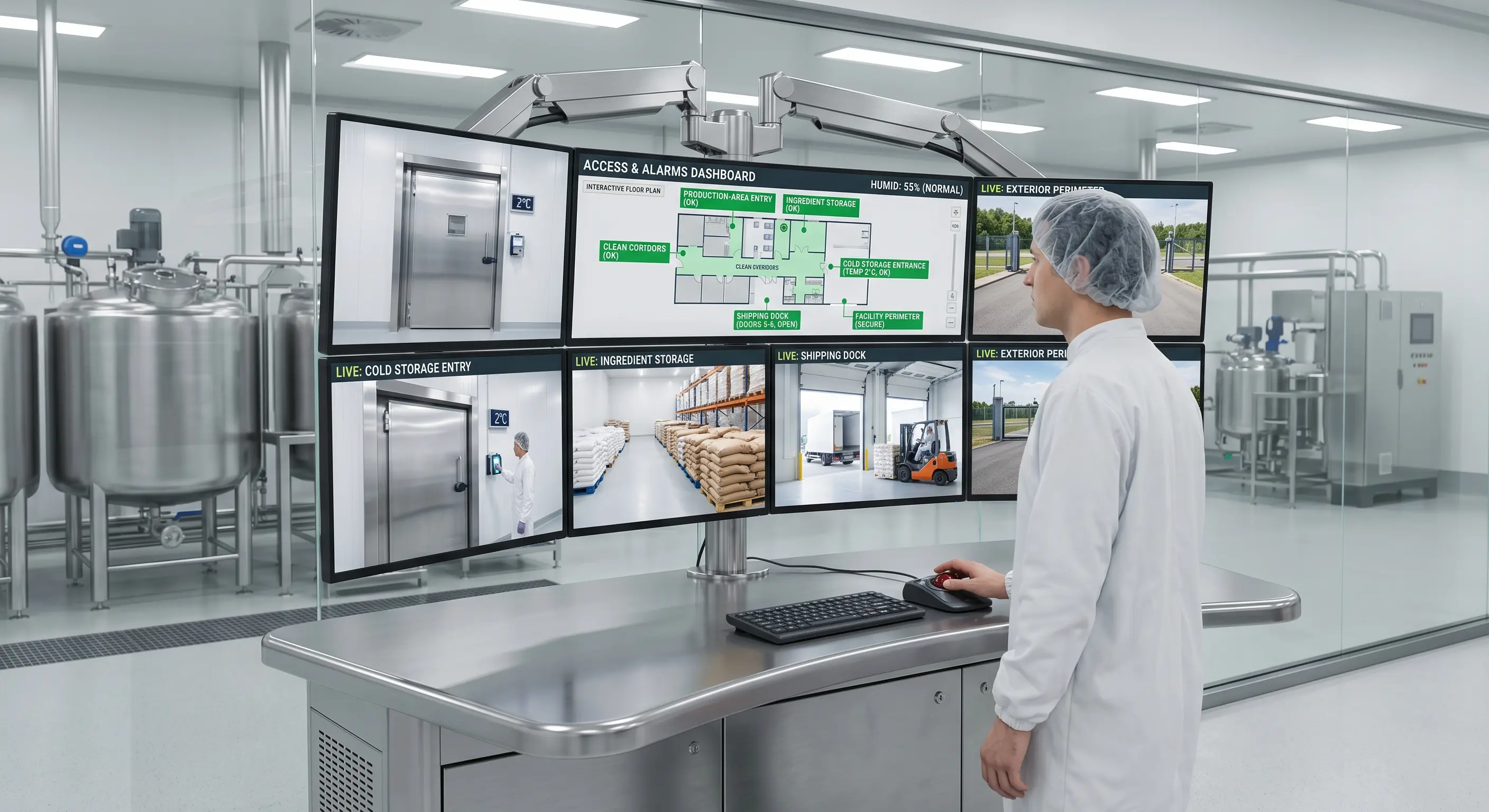
Food processing security systems dashboard for a Chicago-area food manufacturing facility showing access control, video monitoring, alarms, environmental alerts, and dock activity
Integrated food manufacturing security connects access control, video monitoring, alarms, environmental alerts, dock activity, and emergency workflows.

Well-planned food processing security systems should protect more than a building. A strong plan should support people, product, process, restricted areas, high-value inventory, shipping and receiving, environmental conditions, and emergency response.

That may include access control systems, commercial security camera systems, commercial alarm system installation, commercial intercom systems, emergency mass notification systems, visitor/vendor workflows, environmental monitoring, and long-term local support.

This page is built as a food manufacturing security decision guide: what to secure, what to verify, what to ask vendors, and where generic proposals usually fall short.

Trusted by food manufacturers and ingredient producers including

Rana Meal Solutions logo
Nielsen-Massey Vanillas logo
BC Foods logo

Built for the People Responsible for the Plant

Food manufacturing security systems have to help every stakeholder make better decisions.

A food plant security decision usually includes more than one stakeholder. The best food processing security systems help each role understand what needs to be controlled, reviewed, documented, and supported.

Plant Manager

Faster answers

Review access events, dock activity, alarms, and camera footage without waiting for multiple disconnected systems.

Facilities

Reliable infrastructure

Doors, locks, alarms, cameras, wiring, sensors, and supportability need to work in real operating conditions.

QA / Food Safety

Controlled movement

Restricted areas, sanitation rooms, ingredient zones, and visitor/vendor movement should be documented.

Logistics

Dock clarity

Driver arrival, receiving, loading, trailer movement, and after-hours events need useful review workflows.

Operations

Multi-building visibility

Access, alarms, cameras, and environmental alerts should support daily operations and exceptions.

Owner / Executive

Long-term cost control

Modern systems should reduce friction, vendor dependence, blind spots, and expensive-to-maintain legacy workflows.

When Something Happens, Can Your Team Get Answers Fast?

Food processing security systems should make the plant easier to understand when something needs review.

Most buyers are not really asking for “more cameras” or “more card readers.” They are trying to know who entered, what moved, what happened at the dock, whether the right people were notified, and whether the system can support the next operational decision.

Restricted Areas

Who entered sensitive spaces?

Production, QA, ingredient storage, chemical rooms, cold storage, and IT spaces need clear access rules.

Shipping & Receiving

What happened at the dock?

Food processing dock security should make receiving, loading, delivery, trailer movement, and after-hours activity reviewable.

Visitors & Vendors

Where did non-employees go?

Contractors, auditors, sanitation teams, pest control, maintenance vendors, and drivers need documented workflows.

High-Value Inventory

What protects sensitive product?

Ingredients, commodities, finished goods, and storage conditions may need access, video, alarms, and monitoring.

Modernization

Are old systems slowing the team down?

Disconnected, expensive, hard-to-search systems create operational friction.

Emergency Response

Who is in the building right now?

Access control, alerts, visitor records, and video can support emergency visibility.

Food Manufacturing Proof

Proof in food manufacturing: Nielsen-Massey Vanillas

Nielsen-Massey Vanillas needed modern food processing security systems for high-value food inventory across multiple buildings. Umbrella implemented access control, video monitoring, alarms, and humidity sensors to improve visibility, protect inventory, and support emergency awareness.

Watch the food manufacturing security case study testimonial.

From outdated systems to faster answers

The project addressed outdated, expensive-to-maintain systems and gave the team a more modern way to manage security, monitor high-value inventory, and understand who is in the building during an emergency.

Access control Improved building and restricted-area visibility.
Video monitoring Faster review when something needs attention.
Alarms Intrusion coverage connected to response workflows.
Humidity sensors Monitoring for high-value vanilla inventory.

“Umbrella delivered exactly that. Their team implemented access control, video monitoring, alarms, and humidity sensors across multiple buildings.”

Duke Seaton, Senior Logistics Manager, Nielsen-Massey Vanillas

Access Control + Food Defense Support

Control who enters sensitive food plant areas — and make every important event easier to review.

Food plant access control should connect people, doors, schedules, vendors, video, alerts, and emergency visibility into one practical operating workflow.

The best food processing security systems help plant leaders control restricted areas, document vendor and driver movement, verify activity with video, and understand who may be in the building during an emergency.

Food manufacturing plant zone control map showing access control, video verification, visitor workflows, dock activity, environmental monitoring, and emergency visibility
Food manufacturing access control should be planned around zones, workflow, verification, and response.
Zone control Define which people can enter which areas and when.
Video verification Connect door activity with footage that confirms what happened.
Visitor workflow Document non-employee movement through sensitive areas.
Emergency accountability Support visibility into who may be in the building.

What happens after someone badges in?

Food processing access control systems become more valuable when the door event is not isolated. The strongest designs connect credential use, video verification, alerts, manager review, and permission updates.

1 Credential presented
2 Door event logged
3 Camera verifies entry
4 Exception triggers alert
5 Manager reviews event
6 Permissions are updated when needed
Pasta Manufacturing Facility | Bartlett, IL

When a prior access-control installation needs diagnosis

Rana Meal Solutions was facing configuration, process, hardware, and software challenges from a previous access control installation. The lesson is clear: food plant access control is not just product selection. It is hardware, installation, configuration, user workflow, and process.

“Umbrella took the time to show me first-hand the best practices of ‘How it should be installed and perform’ as it relates to electrifying doors for access control.”

Robert D. Roach, Supply Chain Service Manager, Rana Meal Solutions, LLC
Diagnosis matters when prior installs are flawed.
Electrified door hardware has to be designed and installed correctly.
Configuration and process are as important as product selection.
Growing food manufacturers need scalable access-control support.

Bad install vs. best-practice food plant access control

A door can technically unlock and still create long-term operational friction. The right question is whether the system performs reliably, is easy to manage, and supports the facility’s real workflows.

Prior-install risk

  • Door unlocks but hardware is unreliable
  • User groups become messy over time
  • Vendor access is handled manually
  • Access events are hard to interpret
  • Offboarding is inconsistent
  • No clear owner or admin process

Better implementation

  • Door hardware, lock, reader, and controller are matched
  • Role-based groups are mapped to plant zones
  • Temporary access rules and schedules are documented
  • Door events are tied to video review
  • Credential removal process is defined
  • Manager usability and training are part of deployment

Not sure whether your current access control system is helping operations — or creating hidden friction?

Umbrella can review your doors, zones, credentials, vendor workflows, video verification, and long-term support needs.

Request an Assessment

Food plant zone control map

A food manufacturing facility should not be treated as one generic building. Each zone has a different access question and a different workflow.

People Movement

Employee entrances

Who entered, when, and under which shift schedule?

People Movement

Visitor / vendor entry

Who was approved, where were they allowed, and was movement documented?

Product Protection

Ingredient storage

Who accessed high-value, sensitive, or restricted ingredients?

Product Protection

Cold storage

Who entered and did environmental conditions change?

Process Protection

Production entry

Was access expected by role, shift, and operating procedure?

Process Protection

QA lab

Can testing or review spaces be limited to approved users?

Process Protection

Sanitation / chemical room

Is access controlled, scheduled, and auditable?

System Protection

IT / controls room

Who accessed operational systems, panels, or network equipment?

Food Defense Support

Food processing security systems can support food defense procedures without overclaiming compliance.

Security systems are not a complete food defense plan by themselves. But access control, visitor and vendor logs, video monitoring, alarm events, and restricted-area documentation can support a facility’s food defense procedures.

Food defense planning is broader than any single security system. The FDA describes food defense as protecting food from intentional adulteration or tampering, and its Food Defense Plan Builder can help facilities think through procedures, monitoring, corrective actions, verification, and records.

Food processing security systems can support those procedures by helping document access, visitor movement, alarm events, and video review.

Food plant access control securing restricted ingredient storage and production areas with badge access and video verification
Restricted ingredient storage, production areas, chemical rooms, and QA spaces require access control, video verification, and clear procedures.

Strong support for food defense procedures

Access rules are mapped by real plant zones, not just door count.
Visitor, contractor, driver, sanitation, and vendor workflows are documented.
Access events can be reviewed with supporting video.
Alarm events have clear notification and escalation steps.
Environmental alerts identify who receives the notification and what happens next.

Food defense language red flags

The proposal says “compliance-ready” without explaining the actual workflow.
It treats food defense as a camera feature instead of a facility procedure support layer.
It skips ingredient storage, QA, chemical rooms, sanitation rooms, or docks.
It does not explain how records, alerts, video, and access events are reviewed.
It implies the security system alone makes the facility compliant.

Use careful language: security systems can support food defense procedures, but they should not be described as a complete compliance solution by themselves.

When Something Happens, Can Your Team Reconstruct It?

Food processing security systems should show what happened, who was involved, and what needs to happen next.

Buyers do not just need a list of devices. They need to understand how those devices work together during real facility events.

Dock Event

Dock door opens after hours

Alarm event, camera bookmark, manager notification, and review record.

Vendor Event

Contractor arrives for sanitation

Visitor log, temporary access, schedule exception, and route control.

Inventory Event

Humidity threshold changes

Environmental alert, mobile notification, response assignment, and follow-up.

Restricted Area

Ingredient room accessed

Credential event, video verification, audit record, and exception review.

Emergency

Evacuation or shelter-in-place

Emergency notification, occupancy context, access records, and video support.

Docks, Drivers & Vendors

Food processing dock security for visitors, vendors, drivers, and receiving workflows

Food manufacturing facilities often rely on people who are not regular employees: drivers, auditors, inspectors, sanitation teams, pest control providers, equipment technicians, maintenance vendors, temporary workers, and delivery personnel.

For active shipping and receiving areas, food processing security systems should help document driver arrivals, dock-door activity, trailer movement, receiving events, and after-hours exceptions.

Food processing dock security workflow showing driver check-in, dock video monitoring, intercom access, and shipping receiving activity
Shipping and receiving security should document driver check-in, dock activity, trailer movement, and after-hours events.
Person or workflow What your team needs to know How the system should help
Drivers Who arrived, when, and for which dock? Intercom, dock camera, driver check-in
Contractors Where are they allowed to go? Temporary credentials, escort rules, access schedules
Sanitation teams Is after-hours access expected? Scheduled permissions, alarm exceptions, video verification
Auditors and inspectors How is visitor movement documented? Visitor log, badge, host approval
Maintenance vendors Which rooms did they access? Access control, video verification, restricted-route planning
Ingredient deliveries Was receiving activity reviewable? Dock cameras, receiving-area video, retention
Finished goods pickup What trailer or product activity occurred? Video, dock coverage, access records
Food processing security cameras for washdown areas, temperature extremes, production visibility, and footage review
For camera-specific planning, see Umbrella’s food processing security camera requirements guide.

Video Monitoring

Food processing security cameras should be planned around faster answers, not just more views.

Food manufacturing video monitoring should not be planned only around theft prevention. A better system helps managers review dock activity, product movement, access-controlled doors, vendor activity, forklift incidents, shipment questions, and after-hours activity.

Camera placement should be planned around evidence quality, not just visibility. A camera that sees an area may still fail if it cannot show useful detail. Food processing security systems should connect camera placement to the events your team actually needs to review.

Dock and trailer visibility
Production-area entry points
Ingredient and packaging storage
Exportable footage for internal review
Access-control event verification
Retention that matches investigation timelines

For deeper camera-specific planning, Umbrella’s food processing security camera requirements guide covers washdown environments, temperature extremes, production-line visibility, and camera durability.

High-Value Inventory

Food manufacturing environmental monitoring for high-value food inventory

For some food manufacturers, food processing security systems are not only about access or video. They are also about protecting the conditions that preserve product value.

Nielsen-Massey Vanillas is a strong example. Their humidity monitoring became a critical tool for protecting vanilla beans, which are a costly commodity.

Food processing security systems may include environmental monitoring when humidity, temperature, refrigeration, or water exposure could affect high-value inventory.

Humidity-sensitive commodities

Alert managers before product risk escalates.

Cold storage

Support refrigerated or frozen goods visibility.

Water or leak exposure

Route maintenance response before small issues grow.

Multi-building operations

Centralize alerts, mobile access, and remote review.

Food manufacturing environmental monitoring for high-value inventory using humidity, temperature, access control, and mobile alerts
Environmental monitoring can support inventory protection when humidity, temperature, refrigeration, or water exposure matters.

How to Tell Whether a Security Proposal Understands Food Manufacturing

Use this checklist before you buy equipment.

A strong food manufacturing security plan should explain how the system supports the actual plant. Weak food processing security systems usually list devices without explaining what your team will be able to control, review, or improve.

Good security plan

Explains which doors, zones, docks, storage rooms, and production areas need control.
Connects access control events with video verification where review matters.
Includes visitor, vendor, driver, sanitation, and contractor workflows.
Accounts for environmental monitoring when inventory value depends on conditions.
Shows how alarms, cameras, access control, and alerts work together during events.
Includes training, admin ownership, easy management, support over time, and future expansion planning.

Weak or generic proposal

Lists camera counts without explaining what each camera needs to help review.
Treats access control like card readers only, with no door hardware or workflow plan.
Ignores docks, drivers, vendors, sanitation teams, contractors, or after-hours exceptions.
Skips ingredient storage, QA, chemical rooms, cold storage, or IT/control spaces.
Does not explain how managers will search, verify, export, or act on events.
Provides no food manufacturing proof, case study, or local support plan.

Integrated Systems

Integrated food processing security systems

Food processing security systems work best when access control, video, alarms, intercoms, emergency notification, and monitoring workflows are planned together.

Assessment Matrix

Food manufacturing security assessment matrix

Food processing security systems should be assessed by how people, product, process, and response workflows actually move through the facility.

Infographic showing a food manufacturing security assessment matrix for access control, video monitoring, alarms, environmental monitoring, visitor workflows, emergency visibility, and supportability
A food manufacturing security assessment should connect access, video, alarms, environmental monitoring, visitor workflows, emergency visibility, and support over time.
Assessment area What to review Why it matters
Access control Doors, locks, schedules, credentials, offboarding Controls restricted zones and user accountability
Video monitoring Docks, production entry, storage, exterior, retention Helps managers get faster answers
Alarms After-hours zones, dock doors, restricted rooms Supports response workflows
Environmental monitoring Humidity, temperature, refrigeration, water Protects high-value or sensitive inventory
Visitor and vendor control Drivers, auditors, contractors, sanitation teams, pest control Documents non-employee movement
Emergency visibility Occupancy, staff alerts, evacuation, shelter-in-place Helps leaders understand who may be in the building
Easy management and support Mobile access, administrator ownership, training, future expansion Reduces extra work, delays, and blind spots

Local Support

Food processing security systems for Chicago, Bartlett, Naperville, and Northern Illinois

Chicago and Northern Illinois have a large base of food processing, ingredient, packaging, cold storage, and distribution operations. Facilities in the region may need security planning around multi-building operations, industrial parks, cold weather, long winter nights, after-hours shifts, dock activity, local support, and future expansion.

Umbrella Security is based in Naperville and supports food manufacturing and commercial facilities across Chicago and the surrounding suburbs. Umbrella’s food manufacturing experience includes local facilities such as Rana Meal Solutions in Bartlett and Nielsen-Massey Vanillas, along with broader commercial and industrial work across Chicago, Naperville, and Northern Illinois.

For Chicago-area facilities, food processing security systems should be practical to install, easy for managers to use, and supported by a local team that understands how production environments actually operate.

Local assessment

Site-specific review of plant zones, docks, access points, storage, and support areas.

Local implementation

Practical installation planning around production schedules, sanitation, and business continuity.

Local support

Ongoing service when facilities add doors, buildings, users, cameras, or new workflows.

Request a Food Manufacturing Security Assessment

If your food processing security systems are difficult to manage, expensive to maintain, or disconnected from daily operations, Umbrella can help evaluate what should stay, what should be corrected, what should be modernized, and what needs to be integrated more clearly.

A food manufacturing security assessment can help identify access control problems, disconnected cameras, unclear dock visibility, high-value inventory concerns, environmental monitoring gaps, visitor/vendor control issues, and systems that are hard to support over time.

FAQs

Frequently Asked Questions

What are food processing security systems?

Food processing security systems are integrated technologies and procedures used to help protect people, product, production areas, restricted rooms, shipping and receiving, high-value inventory, environmental conditions, and emergency response. They may include access control, video monitoring, alarms, intercoms, visitor management, emergency notification, and environmental monitoring.

What security systems do food manufacturers need?

Food manufacturers may need access control, video monitoring, intrusion alarms, intercoms, emergency notification, visitor and vendor management, environmental monitoring, and mobile access depending on the facility. The right system depends on production flow, product value, facility layout, shifts, restricted areas, dock activity, environmental sensitivity, and support requirements.

How does access control help food processing facilities?

Access control helps food processing facilities manage who can enter production areas, ingredient storage, packaging rooms, sanitation areas, chemical rooms, QA labs, IT rooms, cold storage, and after-hours entrances. It can also help document access events, support staff offboarding, control vendor access, and verify activity with video.

Can access control and visitor management help document contractors, drivers, and sanitation teams?

Yes. Access control and food plant visitor management workflows can help document when contractors, drivers, sanitation teams, auditors, vendors, and other non-employees enter the facility, where they are allowed to go, and whether their activity needs to be reviewed with video or access records.

How can security systems support food defense?

Food processing security systems can support a facility’s food defense and operational-security procedures by helping document access, visitor movement, restricted-area activity, shipping and receiving events, alarm response, and incident review. They should not be described as a complete compliance solution by themselves.

Should food processing security cameras be different from office cameras?

Often, yes. Food processing security cameras may need to be selected around washdown areas, temperature changes, humidity, dust, vibration, lighting, production visibility, and footage review requirements. Camera planning should be based on the environment and what the team needs to verify.

Where should security cameras be placed in food manufacturing facilities?

Common camera locations include employee entrances, visitor entrances, production-area access points, ingredient storage entrances, packaging areas, shipping and receiving, dock doors, exterior doors, parking areas, yard gates, cold storage entrances, and high-value inventory areas. Camera placement should be based on what the facility needs to review, not just where cameras are easiest to install.

Why is environmental monitoring important in food manufacturing security?

Some food manufacturers handle high-value or sensitive inventory that can be affected by humidity, temperature, refrigeration, water exposure, or storage conditions. Food manufacturing environmental monitoring can help alert managers to conditions that may threaten product value or operational continuity.

What should a food manufacturing security assessment include?

A food manufacturing security assessment should review facility layout, production flow, employee entrances, visitor/vendor access, production areas, ingredient storage, packaging areas, QA rooms, sanitation areas, cold storage, shipping and receiving, docks, alarms, video, access control, emergency response, environmental monitoring, and long-term support.

Does Umbrella Security install food processing security systems in Chicago?

Yes. Umbrella Security installs and supports food processing security systems for food manufacturing, ingredient production, commercial, industrial, and logistics facilities across Chicago, Naperville, Bartlett, and Northern Illinois. Umbrella focuses on site-specific planning, integrated systems, practical workflows, and long-term local support.