
Verkada Pricing and the Real Cost of Ownership: A 25-Year Integrator's Investigation
A security system is not a consumer app. Before you sign, the questions that matter are: what do you own, what must you keep renting, what happens when the commercial relationship changes, and how much does it cost to leave?

Findings at a glance
- Verkada is a capable product. G2 shows 4.7/5 across 139 reviews; the platform is now FedRAMP Moderate certified. Any honest analysis starts there.
- License cost can exceed hardware cost. On a 100-camera ten-year model, licenses run nearly 2× the cameras.
- The contract, not a competitor, makes the lock-in case. Verkada's own agreement states that without valid licensing, "hardware will not function as designed."
- Expiration has operational teeth. After grace periods, users lose device access and configuration; alarms and event notifications are disabled.
- Interoperability is real but narrow. RTSP live streaming exists; it is not the same as open-platform ownership.
- The public record is substantial. A $2.95M FTC penalty (for CAN-SPAM — not the breach), a documented 2021 breach, and reported sales-conduct issues all belong in a full evaluation.
Download the Adversarial Verkada RFP Appendix
The 94-point procurement checklist that forces any bidder to answer these questions in writing. Free.
Get the RFP Appendix →Executive conclusion
I have spent 25 years designing, selling, troubleshooting, replacing, and living with enterprise video-surveillance systems. I have watched manufacturers come and go. I have watched customers discover — sometimes years after the ribbon cutting — that the lowest-friction installation was not the lowest-risk ownership decision.
Verkada deserves credit for solving real problems. Its interface is polished. Deployment can be fast. Customers regularly praise the single pane of glass, video quality, remote access, and ease of administration. The federal marketplace now lists Verkada Command Platform as FedRAMP Certified at the Moderate level. Any credible analysis has to acknowledge those facts.
But a security system is not a consumer app. Cameras, doors, alarms, intercoms, evidence, identities, and emergency workflows become part of an organization's operational infrastructure. The decision cannot stop at, "Is the demonstration impressive?" It has to ask: what do we own, what must we keep renting, what happens when the commercial relationship changes, and how much does it cost to leave?
Why I am writing this
I am writing this as an integrator, not as a software reviewer. My responsibility has always been to protect the customer beyond the sale — to design a business-class security system that remains economical, scalable, professional-grade, and serviceable when the original presentation deck is long forgotten.
In our industry, manufacturers love to frame the decision as old versus new: servers versus cloud, complicated versus simple, legacy versus modern. That framing is convenient because it keeps the discussion away from ownership. A cloud-managed architecture can be excellent. A subscription can be reasonable. A proprietary component can be justified. What is unacceptable is allowing convenience to erase the questions of leverage, portability, renewal economics, evidence access, and exit.
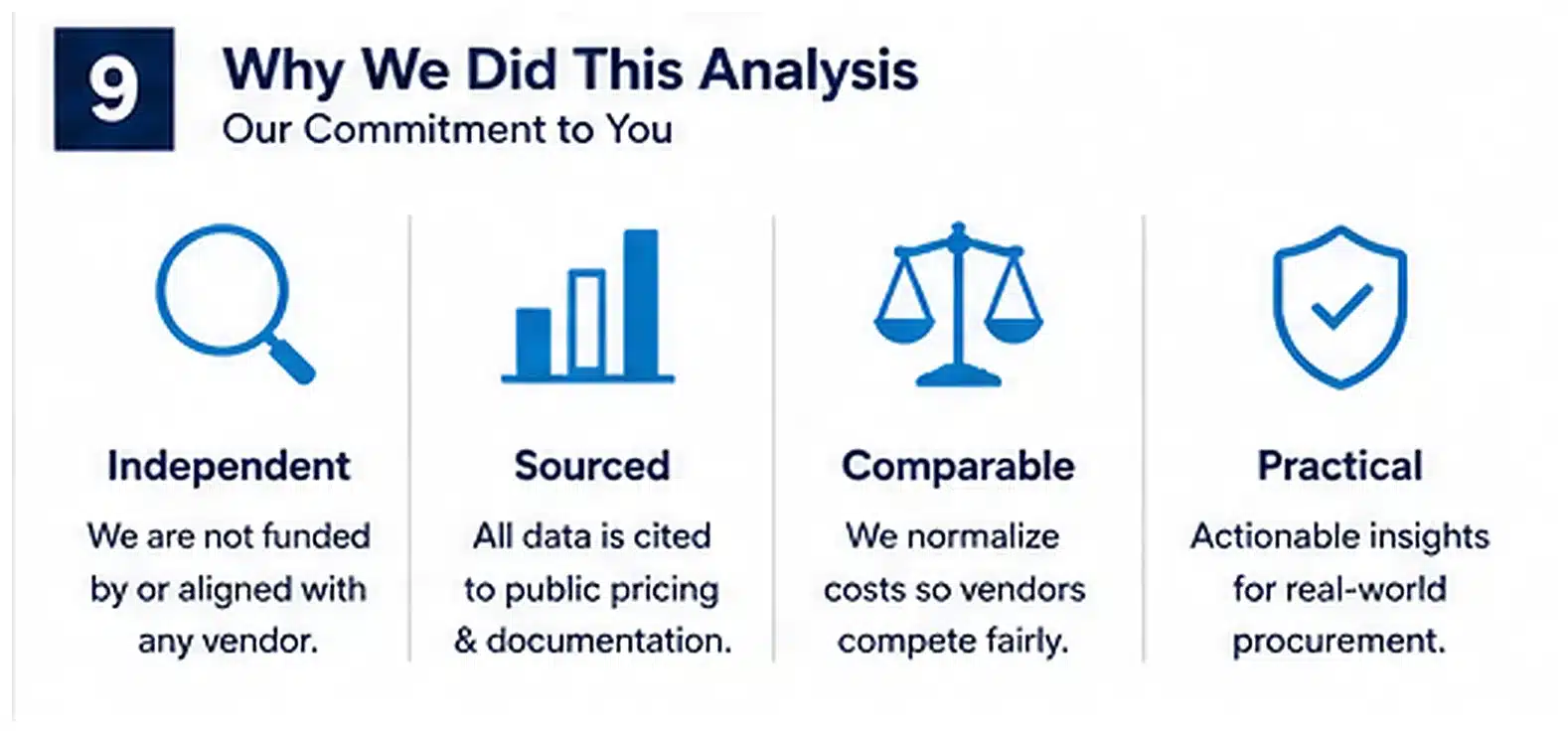
This report is intentionally adversarial in the procurement sense. It does not presume Verkada fails every test. It forces the vendor to answer the tests in writing.
Give the product its due
A serious investigation should begin with what customers actually like. G2's current review record shows a 4.7 out of 5 rating across 139 reviews. Ease of use is the most frequently identified advantage. Customers also praise video quality, centralized administration, support, and the ability to manage multiple physical-security products from one interface.
- Fast, straightforward deployment for many common use cases
- A consistent browser-based experience without a traditional thick VMS client
- Unified video, access, alarms, workplace, intercom, and sensor products
- Remote administration and automatic software delivery
- A current FedRAMP Moderate certification listing for the Command Platform
Those benefits have economic value. In the accompanying TCO workbook, I deliberately assign Verkada fewer annual administration hours than the open-platform scenario. A fair model should not pretend simplicity is free or worthless. It should price the benefit — and then price the dependency that comes with it.
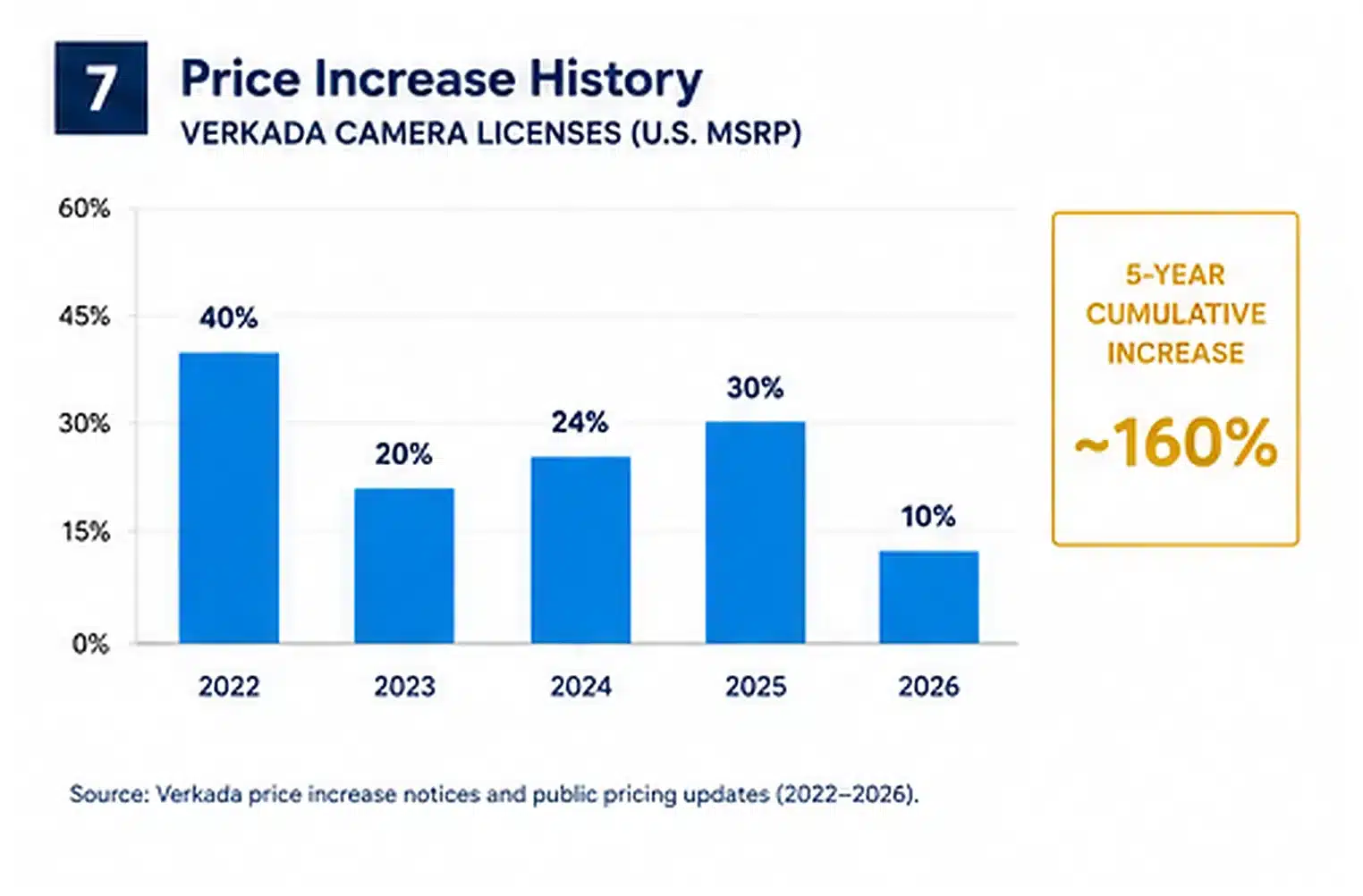
Verkada pricing: public MSRP is not lifecycle transparency
It would be inaccurate in 2026 to say Verkada publishes no prices. The company's June 2026 U.S. pricing overview lists current MSRP across its portfolio. The more accurate criticism is that a buyer can see a camera price without seeing the full economic architecture surrounding that camera.
Return to the 100-camera baseline. At public MSRP, 100 CD43 cameras cost $119,900. Ten-year camera licenses add $219,900. Before installation, mounts, switches, UPS capacity, training, viewing stations, bandwidth, optional cloud storage, replacement labor, or exit, the camera hardware and required ten-year licenses total $339,800. In that subtotal, the licenses are nearly twice the hardware cost.
| 100-camera baseline (public MSRP) | Cost | Share |
|---|---|---|
| Camera hardware (100 × CD43) | $119,900 | 35.3% |
| 10-year camera licenses | $219,900 | 64.7% |
| Subtotal (hardware + required licenses) | $339,800 | 100% |
Excludes installation, mounts, switches, UPS, training, viewing stations, bandwidth, cloud storage, replacement labor, and exit — all of which add to the real total. Source: Verkada June 2026 U.S. pricing overview.
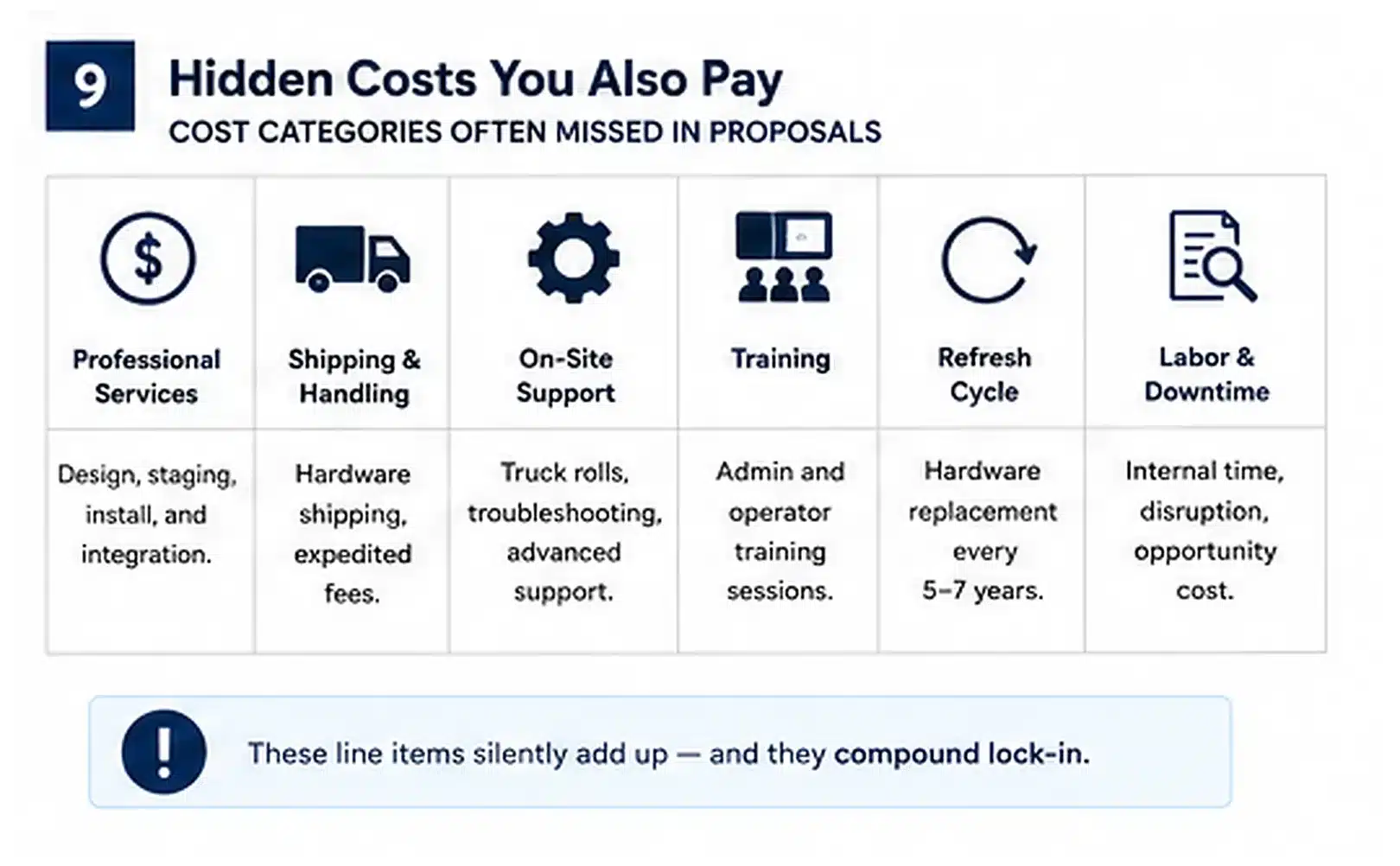
Hidden lifecycle costs buyers routinely miss
Price-increase history
The ten-year model: convenience has value, dependency has a price
The baseline workbook assumes 100 cameras, a five-year Verkada license that renews once inside the horizon, a 5% renewal-price escalation scenario, lower Verkada administration labor, and a Year 10 transition. Under those assumptions, the Verkada scenario has a modeled NPV approximately $102,804 — or 16.4% — higher than the open-platform scenario.
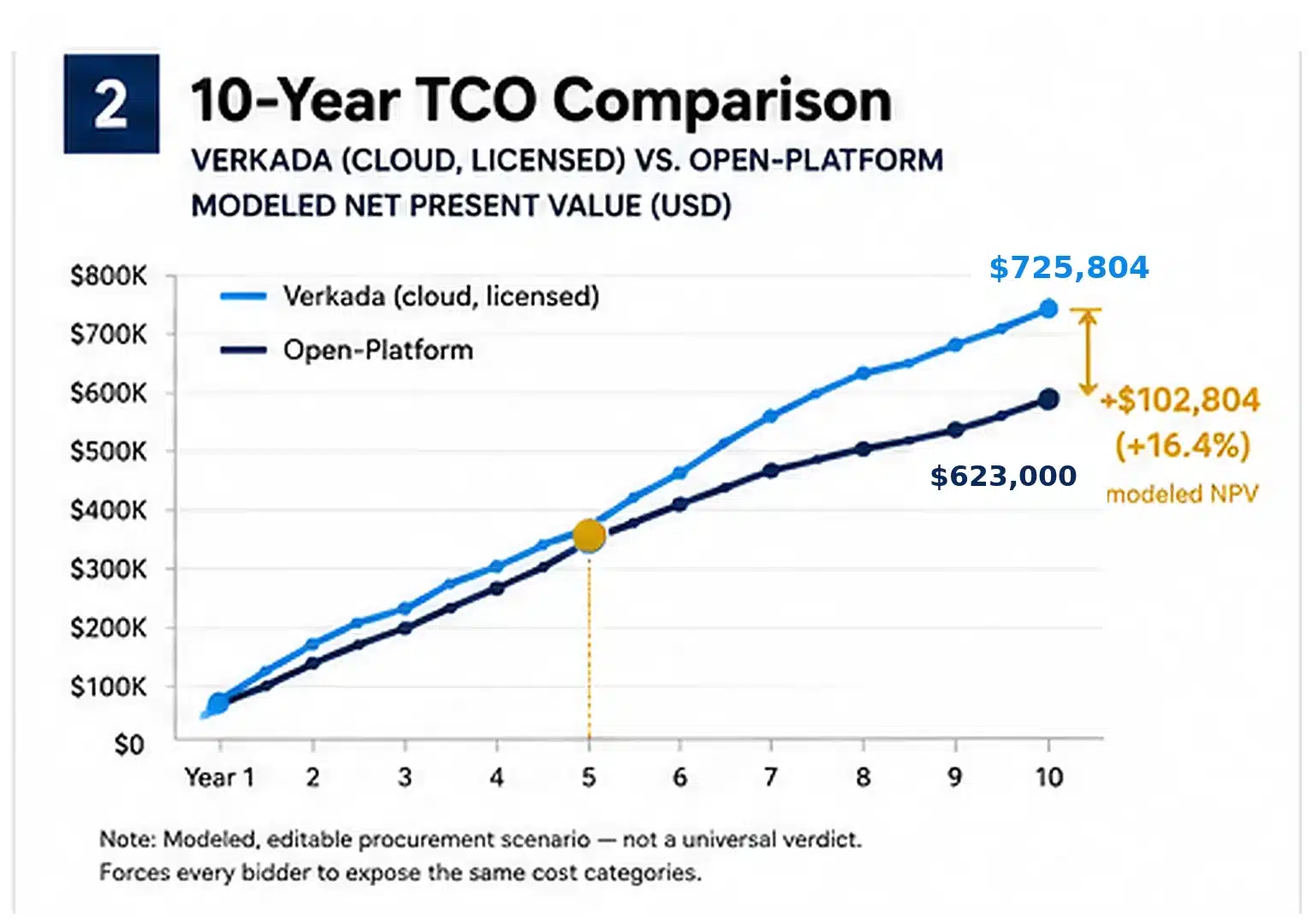
That is not a universal verdict. It is an editable procurement model. Change the reseller discount, the license term, the support rate, labor hours, failure rate, storage design, server refresh, exit year, endpoint reuse, and migration assumptions. The value of the model is not one headline number. The value is forcing every bidder to expose the same cost categories.
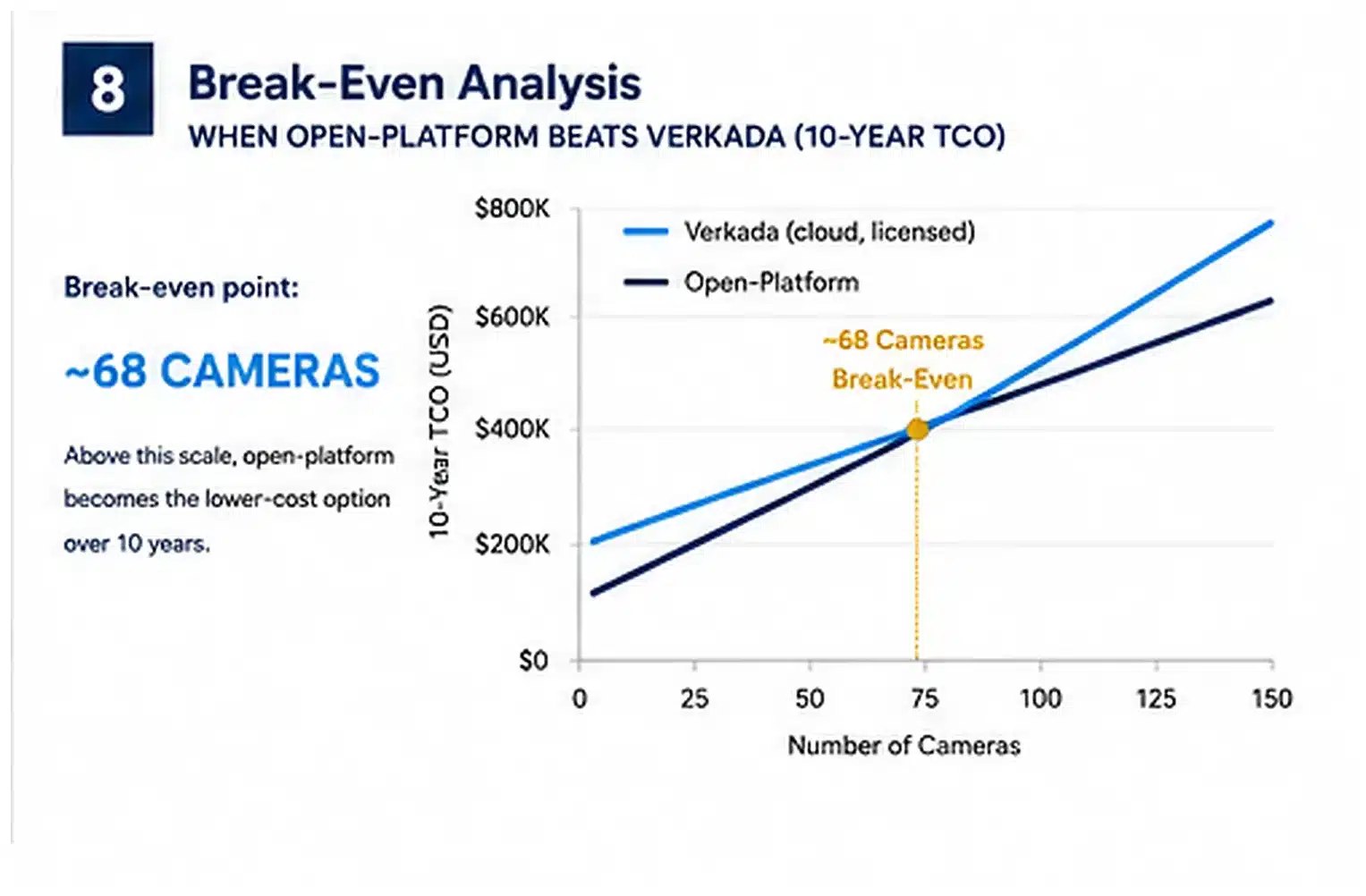
Get an independent 10-year TCO comparison for your exact camera count
No Verkada quote required. A 25-year integrator runs your numbers against open-platform.
Request a TCO Comparison →The lock-in argument — in Verkada's own language
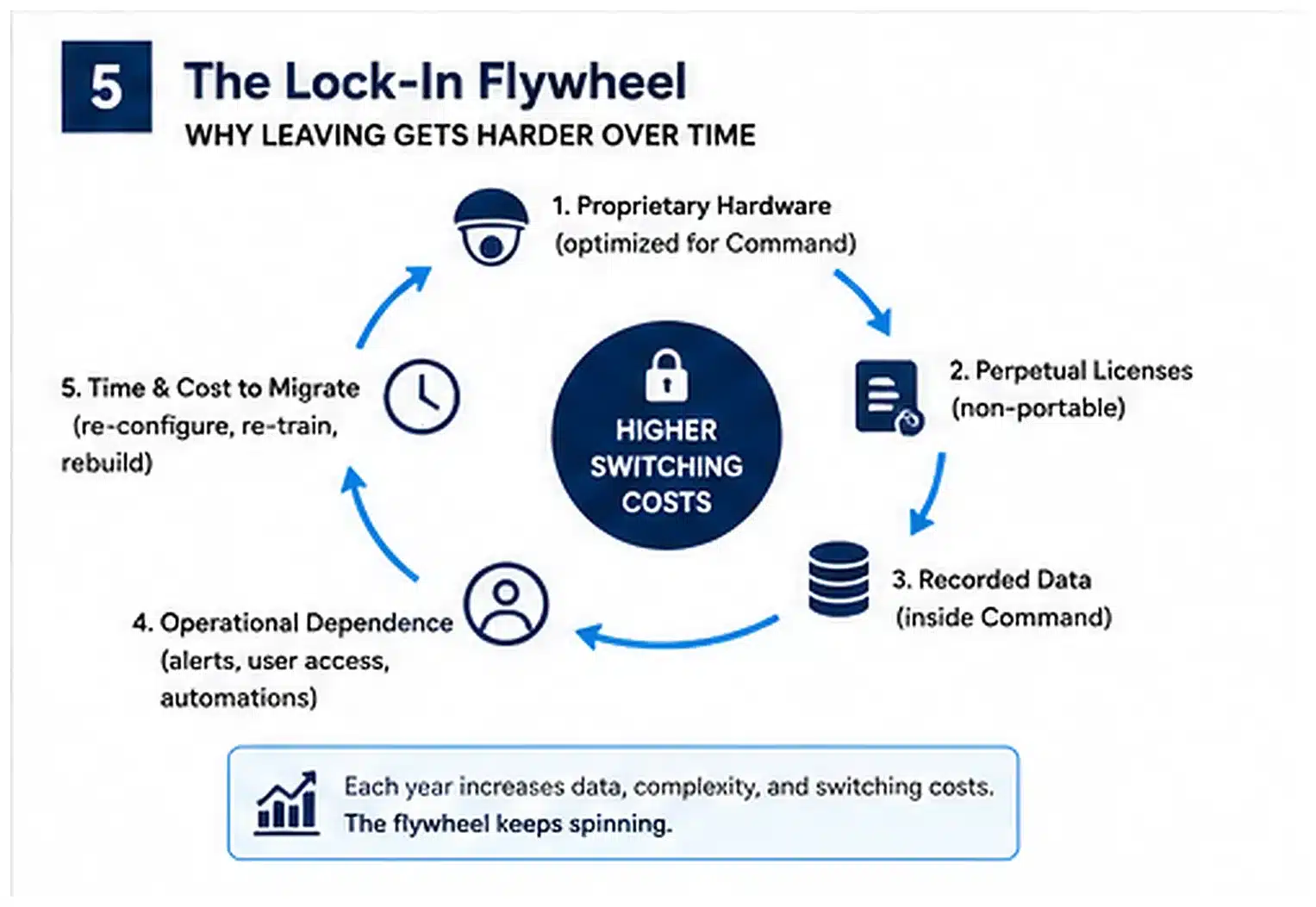
The strongest evidence is not a competitor's brochure or an angry forum post. It is the vendor's contract. Verkada defines valid licensing as the required number and type of licenses for the hardware and features managed through Command. Without valid licensing, the agreement says the customer may have limited or no access to customer data, product features, and software. It then states:
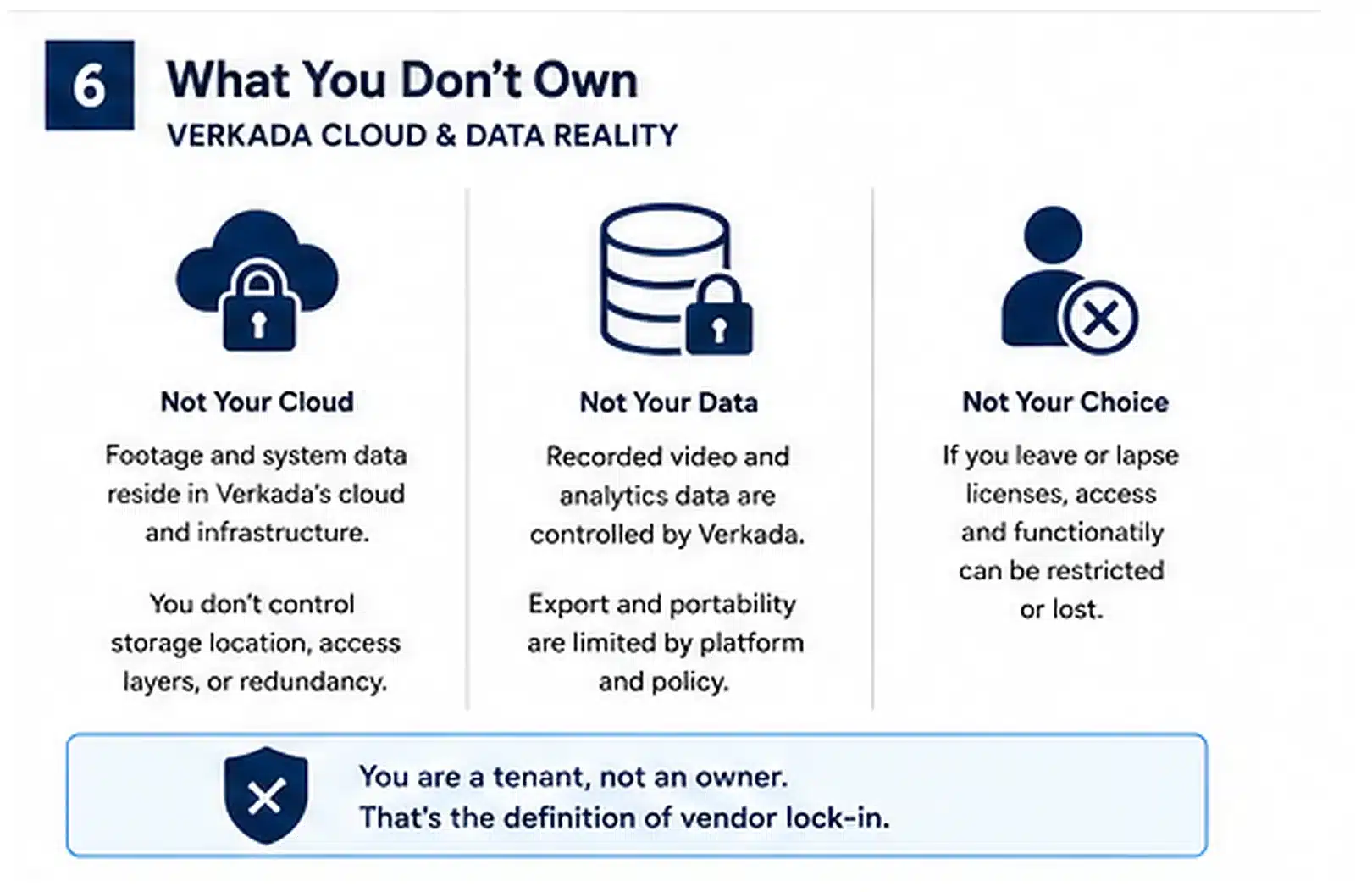
That sentence matters because it defines what the customer is really buying. The organization owns physical devices, but the ordinary use of those devices is conditional on maintaining the commercial relationship. In practical terms, the license is not merely software maintenance. It is the continuing operating right for the installed ecosystem.
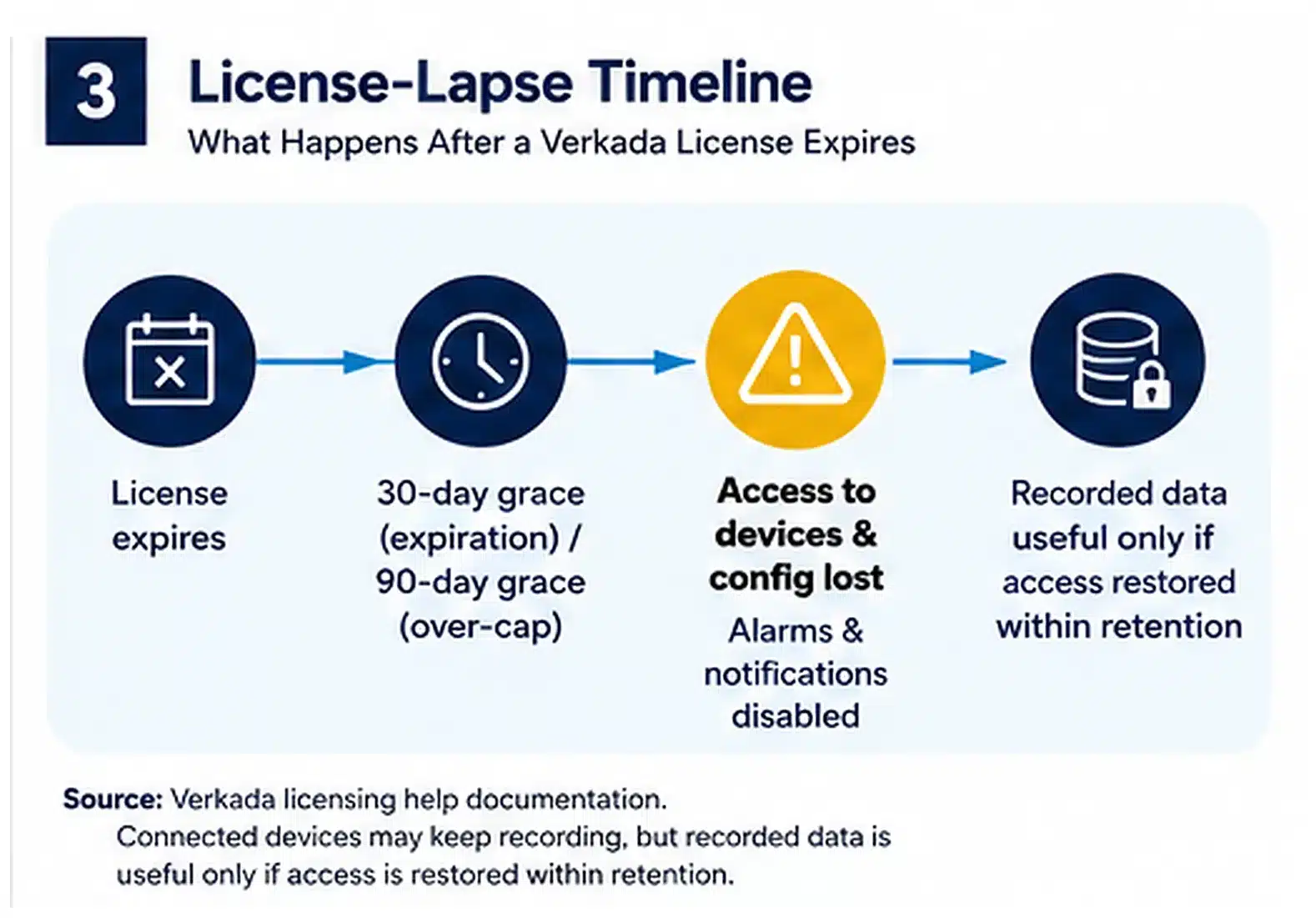
What happens after a Verkada license expires
Verkada's help documentation provides a 30-day grace period for expiration and a 90-day grace period when an organization has more active products than claimed licenses. At the end of the relevant period, users lose access to devices and configuration settings; alarms and event notifications are disabled. Connected devices can continue recording, and badges may continue working, but recorded data becomes useful only if access is restored while it remains inside retention.
This is why I use the word leverage. A renewal decision made while management, alarms, evidence access, and configuration are at risk is not the same as an ordinary maintenance renewal. The installed base creates pressure to accept the vendor's commercial terms or begin a migration under operational duress.
What you actually own
Public records show the installed-base effect
In March 2026, Colchester School District in Vermont issued a Verkada camera-system expansion as a sole-source procurement. Its public bid record said the district already operated Verkada cameras and access-control hardware and required Verkada products for full interoperability with Command and the existing infrastructure.
This is not evidence of wrongdoing. It is evidence of the commercial consequence of standardization. Once video and access control are unified around one proprietary management environment, the next purchase is no longer an open comparison between manufacturers. The existing investment becomes the justification for staying inside the same ecosystem.
A buyer should therefore score two different things: the operational benefit of one interface and the future procurement cost of having only one commercially practical expansion path.
Interoperability: correct the record, then test the limits
I will not make the lazy claim that Verkada cameras cannot send video anywhere else. Verkada now documents RTSP 1.0 live streaming from many cameras directly to third-party applications on the local private network. It allows up to two concurrent streams and identifies model and networking limitations. Verkada also warns that RTSP authentication and transport are not encrypted and recommends segmentation and VPN controls.
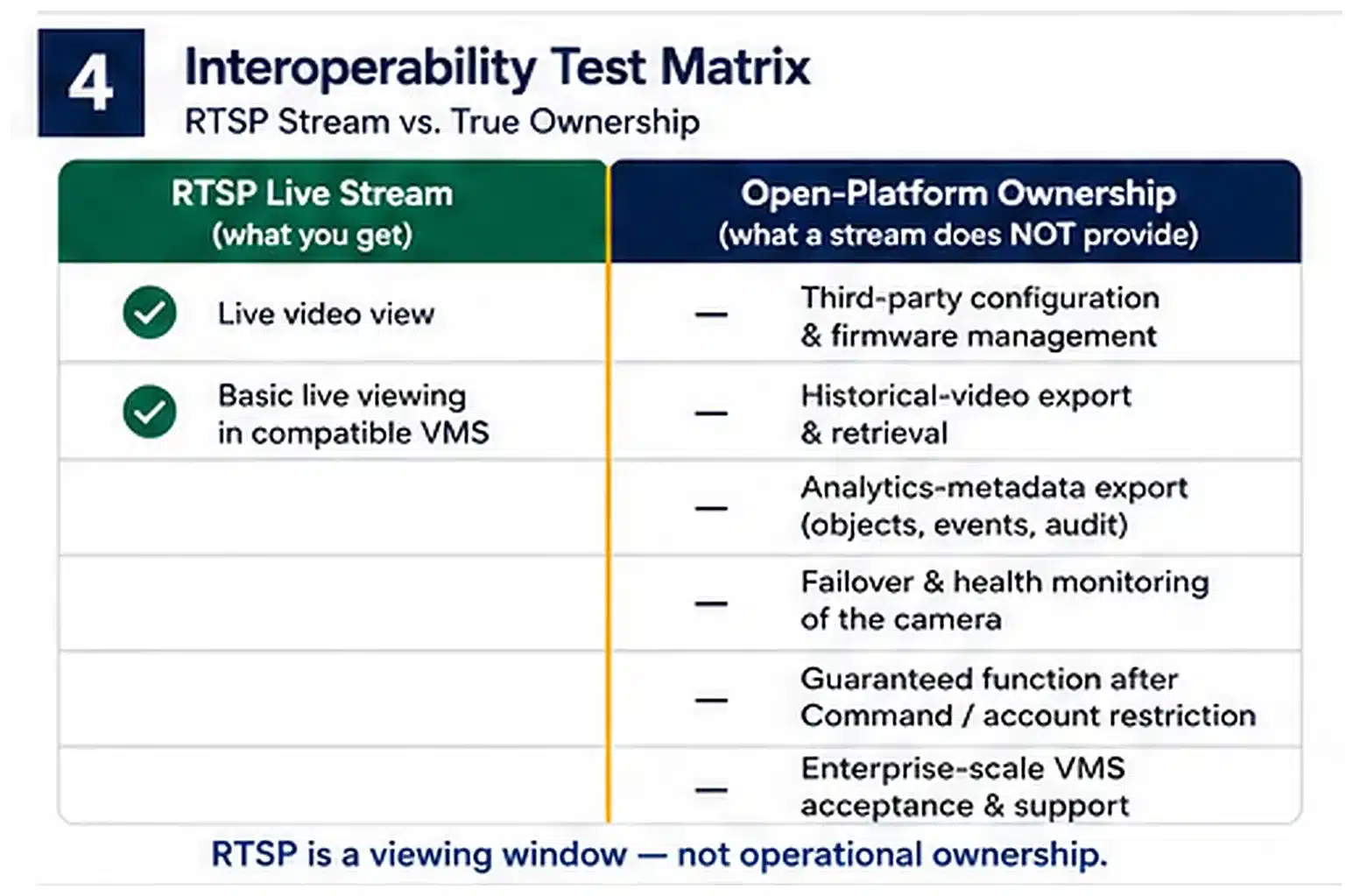
That is legitimate interoperability. It is also narrower than an open-platform ownership claim. A live stream does not automatically provide third-party configuration and firmware management; historical-video access from the camera's proprietary storage; export of analytics metadata, face-search references, maps, roles, audit trails, or event logic; equivalent failover, health monitoring, warranty workflow, or cybersecurity controls; proof that the stream remains enabled or manageable after Command licensing is restricted; or proof that every model and feature can be accepted by an independent VMS at enterprise scale.
The right conclusion is not "open" or "closed" as a marketing adjective. The right conclusion is a test matrix. Require a bidder to connect the exact proposed model to an independent VMS, operate it under a simulated WAN outage, export evidence, remove Command privileges, document what survives, and contractually warrant the result.
IPVM's public headline reporting that a sales director told a school the cameras were "open source" in a winning $1.2 million deal is a reason to demand precise terminology. The premium article should be obtained before relying on details beyond the public headline, but the procurement lesson is straightforward: RTSP support, ONVIF conformance, open source, open platform, and complete reusability are not interchangeable statements.
What customers actually complain about
The customer record is not a one-sided rejection of Verkada. G2 currently reports 139 reviews and a 4.7 rating. That matters. It also reports recurring negative themes.
A nonprofit reviewer said the annual license costs were difficult to absorb even while praising the product. Another reviewer described an enormous bandwidth toll. Others reported inaccurate tailgating or unknown-user events. At the same time, many reviewers describe exceptional support, easy deployment, and high-quality footage.
That is the pattern I expect from a polished proprietary platform: high satisfaction when the use case fits, followed by frustration where budget, connectivity, specialized controls, or lifecycle flexibility matter more.
What Reddit can and cannot prove
Reddit threads and Verkada User discussions are useful lead generators. A current r/videosurveillance thread, for example, asks for a one-time-purchase, on-premises VMS with broad camera support and no continuing subscription. The replies debate perpetual licenses, software-support agreements, ONVIF compatibility, and the tradeoffs of low-cost platforms.
That discussion is relevant because it shows the ownership questions security-system users are asking. It is not proof that Verkada failed a customer, violated a contract, or costs a specific amount. Anonymous posts should guide our questions — not carry our boldest claims.
Verkada, the FTC, and the sales narrative
IPVM has repeatedly scrutinized Verkada's sales and technical representations. Some of that work is behind a subscription wall, so a responsible report should either obtain the full article or use independently accessible corroboration before repeating details. I treat IPVM headlines as leads and its public reports as industry evidence, not as a substitute for primary documentation.
The accessible public-record reporting is substantial. Motherboard reported that IPVM obtained approximately 10,000 Verkada emails from 23 school districts in eight states over a three-month period. The records included repeated unsolicited outreach, free-trial offers, gift-card or meal promotions, and school officials asking to be removed. Motherboard separately reported coordinated outreach involving school officials and Verkada representatives.
The federal record later alleged that Verkada sent more than 30 million commercial emails over three years and failed in multiple ways to meet CAN-SPAM requirements. The settlement's $2.95 million civil penalty was tied to those email-marketing allegations.
Cybersecurity and representations to the market
The March 2021 breach is well documented, but the numbers must be stated carefully. The FTC alleged that an attacker had access to more than 150,000 live customer cameras and other information. Verkada's own incident report used a different measure and said camera data for 97 customer organizations was viewed or exposed, with additional access-control and Wi-Fi credential exposure affecting smaller numbers of customers. These figures describe different scopes and should not be presented as a simple contradiction.
The FTC complaint also alleged inadequate password, encryption, and network controls; misleading claims involving HIPAA and privacy frameworks; and failure to disclose employee or investor relationships behind certain positive reviews. The entered order requires a comprehensive information-security program, third-party assessments, and restrictions on misrepresentation.
It is also fair to acknowledge the present. Verkada Command Platform is now listed as FedRAMP Certified at the Moderate level. That is meaningful evidence of current control maturity. It does not erase history, and history does not prove the current platform is insecure. It means a buyer should examine the current controls while preserving the lessons of what happened.
When the product becomes the instrument: a governance question
Motherboard independently verified reporting that a Verkada sales director used company cameras and face-search capabilities to collect images of female colleagues, which were shared in a Slack channel containing sexually explicit commentary. Employee criticism of the initial response was followed by terminations after internal backlash and media coverage.
Workplace culture alone does not determine whether a camera is technically good. But this incident is directly relevant to governance because the reported misconduct used the same type of surveillance and search capability that the company sells to schools, hospitals, employers, and governments. The question is not whether every employee shares that behavior. The question is whether controls, access, accountability, and executive response were strong enough when the product itself could be abused.
What I would put in the contract
The companion adversarial RFP appendix converts this investigation into procurement language. At minimum, I would require:
- A complete ten-year bill of materials and price schedule — every hardware, software, storage, viewing, connectivity, support, and expansion SKU
- A maximum renewal escalation and a binding rule that negotiated terms control over later online terms
- A function-by-function license-lapse matrix covering recording, live view, playback, export, alarms, notifications, access control, APIs, integrations, RTSP, and administration
- At least 180 days of read-only access and bulk export after expiration or termination
- A third-party VMS acceptance test for every camera model represented as reusable
- A documented answer on whether RTSP remains enabled and manageable after expiration, suspension, account closure, or Command restriction
- Bulk export of video, metadata, audit logs, configurations, maps, users, roles, and legal-hold inventories in documented formats
- Integration-deprecation notice, transition assistance, and remedies for material loss of functionality
- A fixed or not-to-exceed exit price, including data validation and successor-vendor cooperation
- Security-assessment evidence, breach-notification deadlines, support-access controls, and confirmation of compliance with the federal order
- Disclosure of incentives, reference relationships, and material affiliations involving public officials, employees, consultants, resellers, or reviewers
- A right to terminate and receive pro-rata credits if material product or integration functionality is discontinued
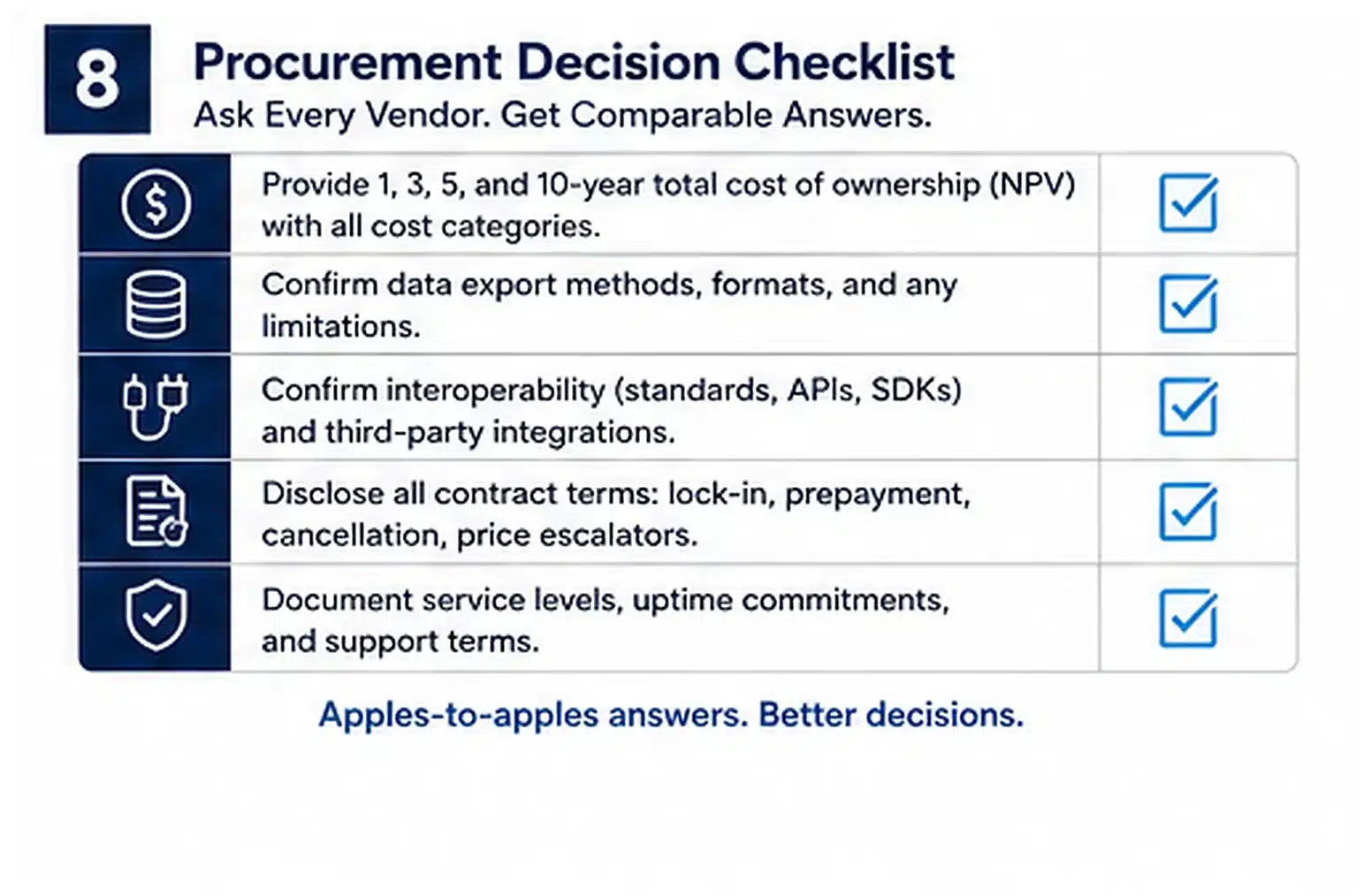
Get the full 94-point Adversarial Verkada RFP Appendix
Attach it to your solicitation and require every bidder to answer in writing. Free with a short form.
Get the RFP Appendix (PDF, 21 pages) →The questions I would ask a Verkada salesperson in the room
- Show me — in the contract, not the demo — every function I lose if I do not renew.
- Can I retrieve historical footage and export evidence after expiration without purchasing a renewal?
- Does an RTSP stream continue after Command access is restricted? Demonstrate it on the proposed model.
- Can a third-party VMS configure, health-monitor, update, and investigate from the camera, or does it receive only a live stream?
- What data can I export in bulk besides video clips?
- What is the exact ten-year price if I expand by 20% in Year 3 and renew in Year 5?
- Which online terms may change after signature, and which negotiated terms override them?
- What happens to alarms and event notifications during a billing dispute?
- How much prepaid license value is transferable or refundable if I decommission a site?
- Give me three customers that migrated away and let me ask them what the exit cost.
Bottom line
I am not against cloud. I am not against subscriptions. I am not against Verkada simply because it is Verkada. I am against allowing a polished demonstration to substitute for an ownership analysis.
Verkada can be the right choice for an organization that values simplicity, accepts the recurring commercial relationship, negotiates strong protections, and understands the exit. It is the wrong choice when a customer believes the hardware purchase creates independent operating control that the contract does not actually provide.
After 25 years in this industry, I have learned that the most expensive security system is not always the one with the largest first-year proposal. It is the system that removes competition after installation, limits your choices at renewal, and makes replacement the only credible path to independence.

Evaluating Verkada in the Chicago area?
Umbrella Security Systems is a commercial-only integrator headquartered in Naperville, serving the Chicago metro. If you're weighing a Verkada quote — or facing a renewal you're not sure about — we'll run an independent TCO comparison against open-platform options with no obligation. See our access control systems and commercial security camera work, explore open-platform alternatives to Verkada, review commercial camera installation, or get in touch.
Frequently asked questions
How much does Verkada cost for 100 cameras?
At public MSRP, 100 CD43 cameras are about $119,900, and ten-year camera licenses add about $219,900 — roughly $339,800 for hardware plus required ten-year licenses, before installation, switches, storage, or exit. Licenses run nearly twice the hardware cost.
Can I access Verkada footage after my license expires?
After Verkada's grace periods (30 days for expiration, 90 days for over-cap), users lose access to devices and configuration and alarms are disabled. Devices may keep recording, but recorded data is only useful if access is restored while it remains inside retention.
Is Verkada an open platform?
Verkada documents RTSP 1.0 live streaming to third-party applications on the local network, which is legitimate interoperability — but narrower than open-platform ownership. It does not by itself provide third-party configuration, historical-video export, analytics-metadata export, or guaranteed function after Command licensing is restricted.
Why is Verkada so expensive?
The recurring license is the main driver. On a ten-year model the licenses can cost nearly twice the camera hardware, and the vendor agreement states hardware will not function as designed without valid licensing — so the license is effectively the operating right for the system, not just software maintenance.
What was the Verkada FTC settlement?
In 2024 the FTC settled with Verkada for a $2.95 million penalty — the largest ever for a CAN-SPAM violation, tied to email-marketing allegations, not the 2021 breach. Separate security and deception allegations produced injunctive obligations including a comprehensive information-security program.
Methodology and claim discipline
This report uses an evidence hierarchy. Grade A sources are vendor contracts and documentation, government records, official price lists, and public procurement records. Grade B sources are independently reported investigations and verified review platforms. Grade C sources are anonymous or pseudonymous discussions used to identify themes. Allegations are attributed as allegations; forum posts are not treated as proof; current positive controls are included where verifiable.
- S-01 | Grade A | Verkada official pricing: June 2026 U.S. MSRP catalog. Establishes public list prices for cameras, licenses, cloud storage, viewing stations and other products. https://docs.verkada.com/docs/pricing-overview.pdf
- S-02 | Grade A | Verkada End User Agreement: Valid licensing, co-termination, license term, access to customer data and software, and the statement that hardware will not function as designed without valid licensing. https://legal.verkada.com/
- S-03 | Grade A | Verkada licensing help: Thirty-day expired-license grace period, 90-day over-cap period, restricted Command access, disabled alarms/event notifications, and continued local recording subject to retention. https://help.verkada.com/command/licensing/manage-your-licenses
- S-04 | Grade A | Verkada RTSP help: Documents local RTSP 1.0 live streaming to third-party applications, private-address limitations, unencrypted transport, model exceptions, and a two-stream limit. https://help.verkada.com/verkada-cameras/video-streaming-and-sharing/live-streaming/low-latency-rtsp-streaming
- S-05 | Grade A | Verkada 2026 pricing update: Confirms list-price changes effective June 5, 2026 and that new prices apply to renewal or expansion after existing terms. https://www.verkada.com/blog/2026-pricing-update/
- S-06 | Grade A | FTC enforcement release: Government allegations concerning security practices, deceptive representations, undisclosed reviewer relationships and CAN-SPAM violations; identifies the $2.95 million penalty as the CAN-SPAM penalty. https://www.ftc.gov/news-events/news/press-releases/2024/08/ftc-takes-action-against-security-camera-firm-verkada-over-charges-it-failed-secure-videos-other
- S-07 | Grade A | FTC case docket: Shows the entered stipulated order and federal case record. https://www.ftc.gov/legal-library/browse/cases-proceedings/2123068-verkada-inc-us-v
- S-08 | Grade A | Verkada incident report: Company account of the March 2021 incident, including affected customer organizations and categories of exposed data. https://www.verkada.com/security-update/report/
- S-09 | Grade A | FedRAMP Marketplace: Current listing for Verkada Command Platform as FedRAMP Certified, Class C Moderate. Included to recognize present-day security progress. https://marketplace.fedramp.gov/
- S-10 | Grade A | Vermont public procurement record: Colchester School District describes its 2026 expansion as sole-source because of existing Verkada Command, camera and access-control investments and interoperability. https://www.vermontbusinessregistry.com/BidPreview.aspx?BidID=73407
- S-11 | Grade B | G2 verified-user review record: Balanced customer evidence: strong overall satisfaction and ease of use, with recurring complaints about expense, access, connectivity, missing features and detection accuracy. https://www.g2.com/products/verkada/reviews
- S-12 | Grade B | IPVM: open-source representation report: IPVM headline reports that a Verkada sales director told a school the cameras were open source in a winning $1.2 million deal. Premium details should be independently obtained before quoting beyond the public headline. https://ipvm.com/reports/verkada-open-source
- S-13 | Grade B | IPVM: 2021 mass-hack report: Industry reporting on the 2021 compromise. Used only alongside the FTC record and Verkada incident report. https://ipvm.com/reports/verkada-hack
- S-14 | Grade B | VICE/Motherboard workplace-surveillance report: Independent reporting and source verification concerning employees’ use of Verkada cameras and face-search tools to target female colleagues. https://www.vice.com/en/article/surveillance-startup-used-own-cameras-to-harass-coworkers/
- S-15 | Grade B | VICE/Motherboard school-marketing investigation: Public-record reporting about aggressive school-district outreach, gift-card offers, free trials and IPVM’s finding of approximately 10,000 emails across 23 districts in eight states over three months. https://www.vice.com/en/article/when-school-superintendents-market-surveillance-cameras/
- S-16 | Grade C | Reddit user discussion: A user discussion illustrating demand for on-premises, open-camera and nonrecurring VMS options. It is context, not proof of a Verkada-specific fact. https://www.reddit.com/r/videosurveillance/comments/1qspspa/does_such_a_vms_exist_lic_cost_100camera_no/
- S-17 | Grade B | Glassdoor employee review: Anonymous employee account alleging a toxic sales culture and camera misuse. Corroborative context only; not used alone to establish facts. https://www.glassdoor.com/Reviews/Employee-Review-Verkada-E2153775-RVW34528250.htm
- S-18 | Grade A | Verkada camera deletion guidance: States that deleting a camera removes its associated footage and settings; supports migration and legal-hold controls. https://help.verkada.com/verkada-cameras/configuration-and-setup/delete-a-camera