

Unfortunately, a problem we continue to face is the unpredictable event of intruders and active shooters within schools and the evolving standard (and laws) around compliant classroom door lockdown devices. Even the best school security system cannot predict these events, and the teachers and children typically don’t have enough time to evacuate in an emergency. Effective classroom door safety and lockdowns are necessary to prevent intruders from entering the classroom. Even in these situations, using illegal classroom barricades is never the answer. This is where our emergency door locks for school come in, offering a reliable solution.
What Are Classroom Door Lockdown Devices?
Classroom door lockdown devices are security hardware solutions that allow teachers to secure classroom doors from inside the room during an emergency — without opening the door or stepping into the hallway.
For school administrators and facilities directors, the goal is clear:
-
Improve emergency response time
-
Reduce exposure during active threats
-
Maintain fire and life safety compliance
-
Avoid ADA violations
-
Minimize liability
Not all products marketed as “school lockdown devices” meet those standards.
Get a Quote
Every Door & School is Different- Let us help you design the right LEGAL Classroom Door Lockdown Solution to enhance classroom door safety.
Illegal Classroom Door Lockdown Devices
As of late, many school security systems and improvised door barricade solutions have been portrayed in the media or even put out on the market. Though they seem like an innovative, quick on-site solution, many people do not know that these barricade systems are illegal. Some illegal barricade devices work by blocking the scissor-action door closers at the top of a door. Though this method can secure doors against attackers, it is inaccessible to most students, anyone with a mobility challenge, and students who are shorter than the required span of reach necessary to mount and dismount the devices. Along with that illegal barricade, devices are put into place with the assumption that the assailant will be outside the classroom when the assailant barricades themselves inside with the victims in a variety of cases. This essentially means that a barricade device that is not easily dismountable prevents victims from getting out and first responders from getting in.
An assortment of these improvised barricade systems either fall short of complying with or just wholly disregard building fire safety codes, accessibility requirements, and safety recommendations. Installing our secure doors for school is not only legal but ensures the utmost classroom door safety.
Types of Classroom Door Lockdown Devices

1. Classroom Function (Intruder Function) Locks
These locks allow teachers to lock the classroom door from inside using a key, without opening the door.
Advantages:
-
Generally fire code compliant
-
Maintains single-motion egress
-
No floor obstruction
-
Minimal staff retraining
Considerations:
-
Requires key control
-
No remote lockdown feature
Best for: Schools upgrading traditional hardware while maintaining compliance.
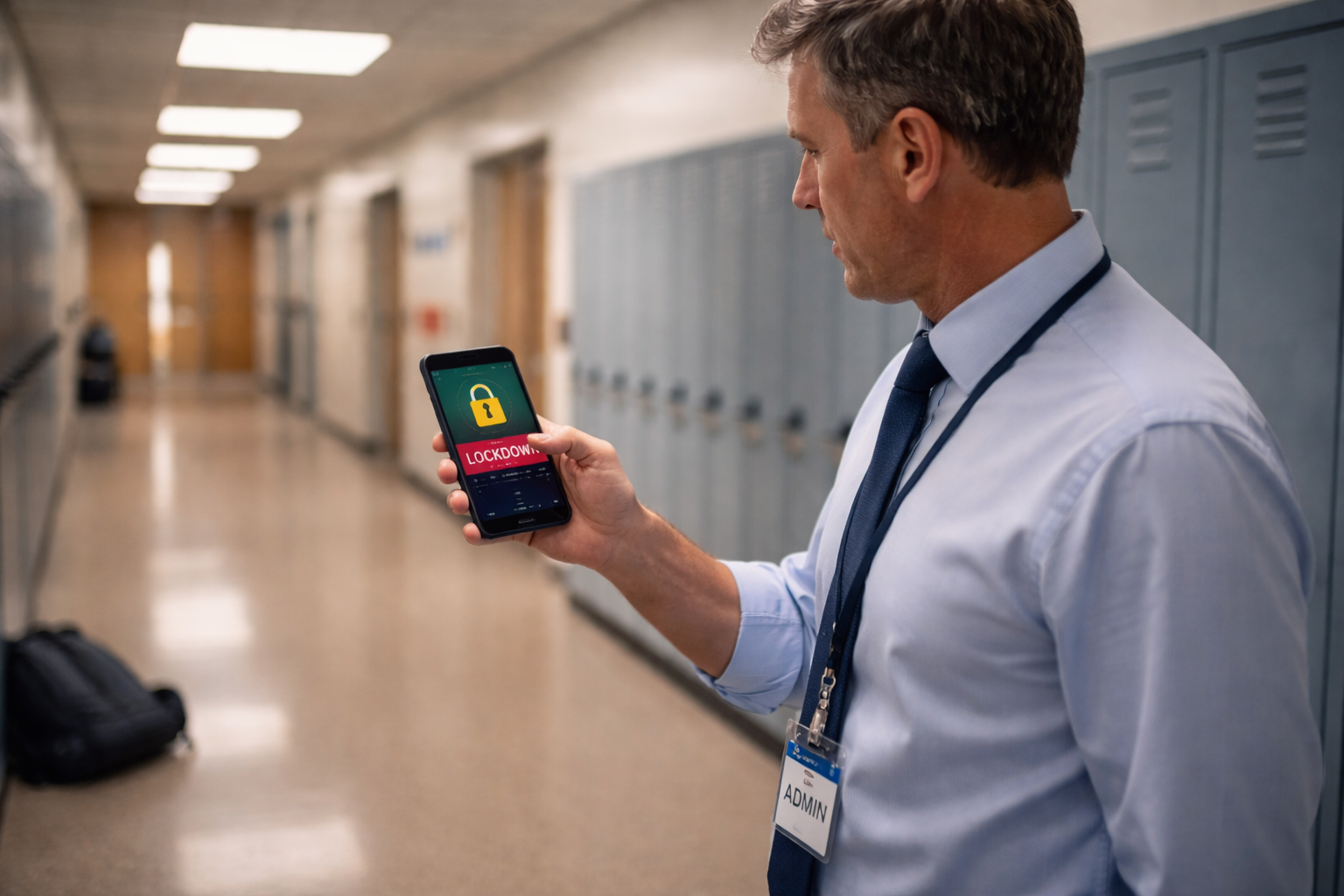
2. Electronic Lockdown & Access Control Systems
These systems allow remote or push-button lockdown of individual classrooms or entire campuses.
Advantages:
-
Immediate campus-wide lockdown
-
Integration with access control
-
Audit tracking
-
Scalable district-wide
Considerations:
-
Higher upfront investment
-
Infrastructure required
Best for: District-wide modernization initiatives.
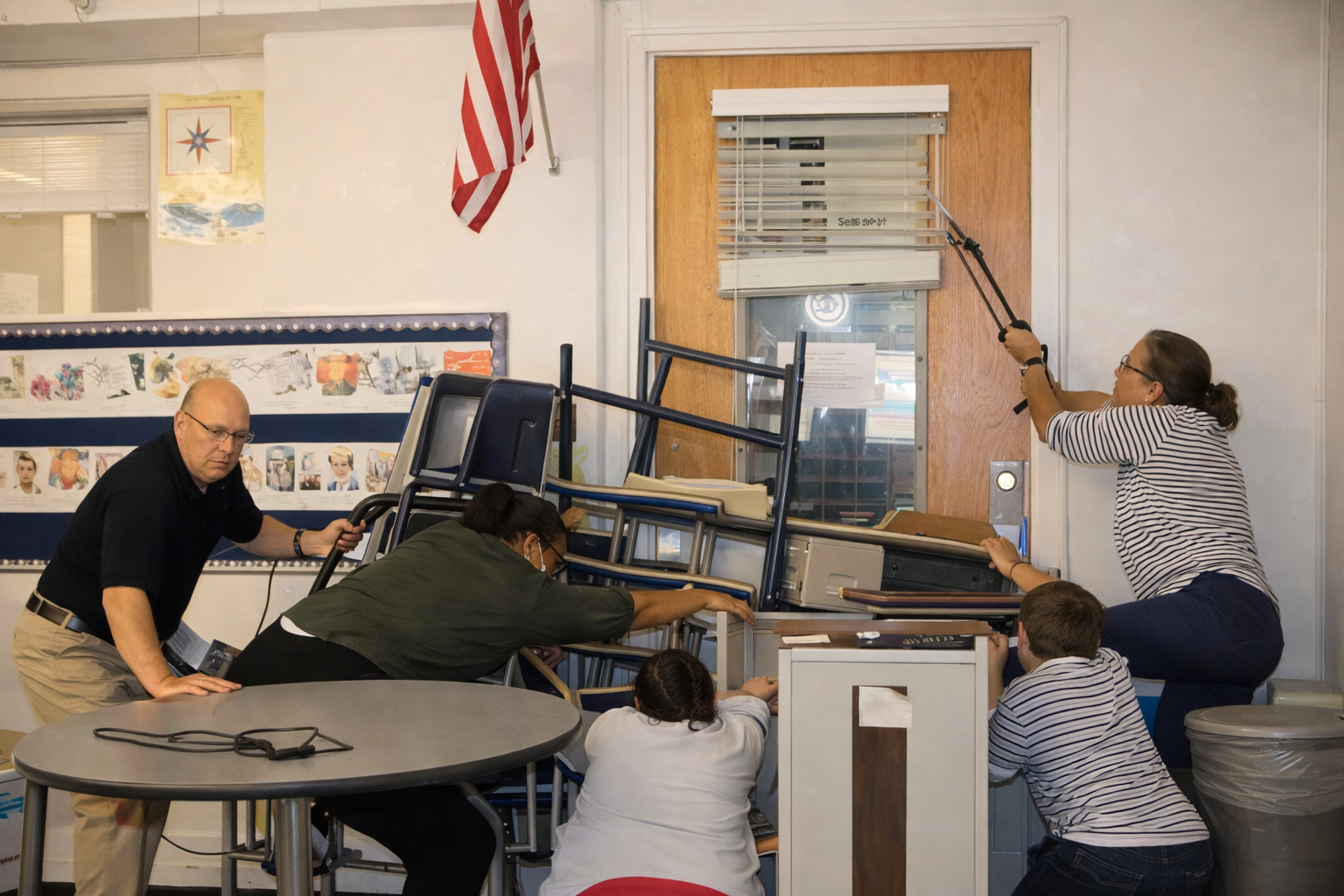
3. Retrofit & Barricade Devices
Some aftermarket devices attach to doors to block entry.
Important: Many barricade-style classroom door devices may conflict with:
-
International Building Code (IBC)
-
NFPA 101 Life Safety Code
-
ADA accessibility standards
If a device prevents one-motion egress or requires special knowledge to disengage, it may create liability.
Before purchasing, verify approval with your local Authority Having Jurisdiction (AHJ).
Why Schools Are Re-Evaluating Door Hardware
Over the past decade, K–12 schools have shifted from corridor-side keyed locks to inside-operable locking systems.
Before COVID, many schools prioritized access control and visitor management. Today, administrators are focused on:
-
Faster classroom lockdown capability
-
Code-compliant hardware upgrades
-
Integrated campus-wide security systems
-
Insurance and liability risk mitigation
Today intent has shifted toward compliance like:
-
best classroom door lockdown devices
-
classroom barricade devices fire code
-
are classroom door barricades legal
-
intruder function classroom locks
This page addresses those concerns directly.
Is Your School Prepared for Emergencies?
Ensuring your school is ready to handle an active shooter situation or similar emergency is crucial. Here’s a breakdown of what you should consider:
Training and Preparedness
- Regular Drills: Conduct regular emergency drills to ensure students and staff know the correct procedures.
- Comprehensive Training: Engage security experts to provide training sessions that cover crisis response and identify risk factors.
- Collaborative Planning: Work with local law enforcement and security consultants to develop a tailored emergency response plan.
Evaluating Your Current Systems
Take the time to assess your current security measures. Consider the following questions:
- Have you recently upgraded your security hardware?
- Are all staff members trained to handle emergencies effectively?
- Does your system allow for quick and efficient communication in a crisis?
- • Have you integrated security barriers and gates to restrict unauthorized access during emergencies?
By implementing and maintaining these systems and practices, your school can be better prepared to handle emergencies promptly and efficiently.
NASFM Classroom Door Security
National Association of State Fire Marshals Regulations on Classroom Door Lockdown Devices:
- The door should be lockable from inside the classroom without requiring the door to be opened.
- Egress from the classroom through the classroom door should be possible without using a key, a tool, any special knowledge, or effort.
- For egress, unlatching the classroom door from inside the classroom should be accomplished with one operation.
- The classroom door should be lockable and unlockable from outside the classroom.
- Door operating hardware should be operable without tight grasping, tight pinching, or twisting of the wrist.
- Door hardware and operable parts should be located between 34 and 48 inches above the floor.
- The bottom 10 inches of the “push” side of the door surface should be smooth.
- If the school building does not have an automatic fire sprinkler system, the classroom door and door hardware may be required to be fire-rated, and the door should be self-closing and self-latching.
- If the door is required to be fire-rated, the door should not be modified in any way that invalidates the fire-rating of the door and door hardware.
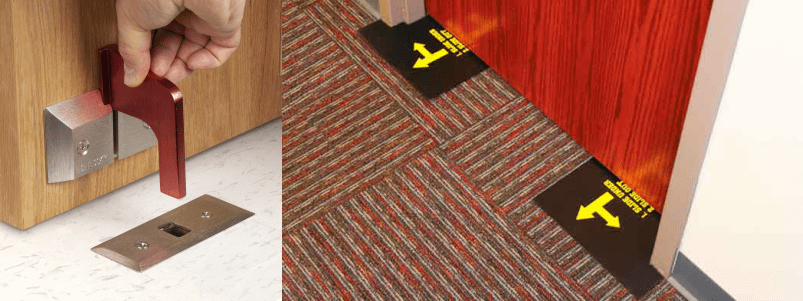
Floor Barricade Systems
NOT mounted 34-48 inches above the floor
NOT able to be used with ease by both handicapped individuals in wheelchairs and those using walkers
NOT able to be unlocked from the outside
NOT dismantlable without special knowledge or effort
NOT operable with one hand
NOT compliant with fire-rating
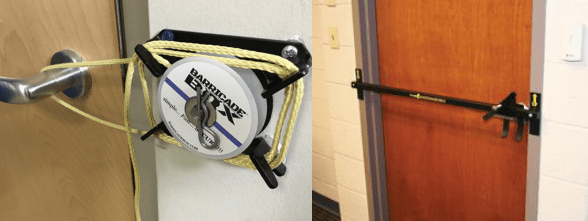
Mid-Mounted Barricade Systems
NOT able to be unlocked from the outside
NOT dismantlable without special knowledge or effort
NOT operable with one hand
NOT compliant with fire-rating
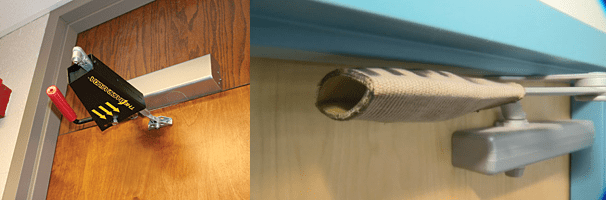
Door-Closer Barricade Systems
NOT mounted 34-48 inches above the floor
NOT easily usable by both individuals in wheelchairs and those using walkers
NOT able to be unlocked from the outside
NOT dismantlable without special knowledge or effort
NOT operable with one hand
NOT compliant with fire-rating
Fire Code & ADA Compliance Requirements for Schools
This is where many districts make costly mistakes.
A compliant classroom door must:
-
Allow free egress with one motion
-
Not require special tools or knowledge
-
Not obstruct door swing
-
Operate without tight grasping, pinching, or twisting
-
Meet IBC and NFPA Life Safety Code standards
Security that compromises evacuation safety creates new risk.
If a vendor cannot clearly document compliance, proceed cautiously.

Accessibility and security are becoming a conflict within K-12 schools due to these Classroom Door Lockdown Devices. Parents, law enforcement, and school administrators are fighting against fire marshals, code officials, and the disabled community. Keeping children safe needs to be the ultimate goal of all of these debates, but violating building codes and Federal Accessibility Laws cannot be the way to achieve this. Statistics have shown that there are more school fires than school shooters. So, schools must not implement a hazardous system and block escape routes in case of a fire. Yet, we do not want to diminish the importance of devices that will safeguard classrooms against active shooters and intruders. Educational facilities simply must use devices that are still compliant with fire codes and disability act laws.
How to Choose the Best Classroom Door Lockdown Device
When evaluating options, school administrators should ask:
- Can the door be locked from inside without opening it?
- Does it preserve single-motion exit?
- Has it been reviewed for fire code compliance?
- Can staff deploy it within seconds?
- Does it integrate with broader campus security?
- Will it pass inspection by local authorities?
The best lockdown solution balances:
-
Speed
-
Compliance
-
Durability
-
Integration
-
Long-term liability protection
Comparison of Lockdown Device Options
| Feature | Classroom Function Lock | Electronic Lockdown | Barricade Device |
|---|---|---|---|
| Inside Locking | Yes | Yes | Yes |
| Remote Lockdown | No | Yes | No |
| Fire Code Compliance | Yes | Yes | Often Questionable |
| ADA Compliance | Yes | Yes | Often Questionable |
| Cost | Moderate | Higher | Lower |
Fortunately, there are classroom lockdown devices available that are specifically made to allow everyone, including individuals with disabilities, to swiftly exit a school during emergencies like fires, bomb threats, or active shooter incidents.
Before choosing a lockdown solution for classrooms, it’s crucial for school administrators and building managers to identify the essential features that guarantee both effectiveness and compliance. The right choice not only boosts security but also fits well within the educational environment.
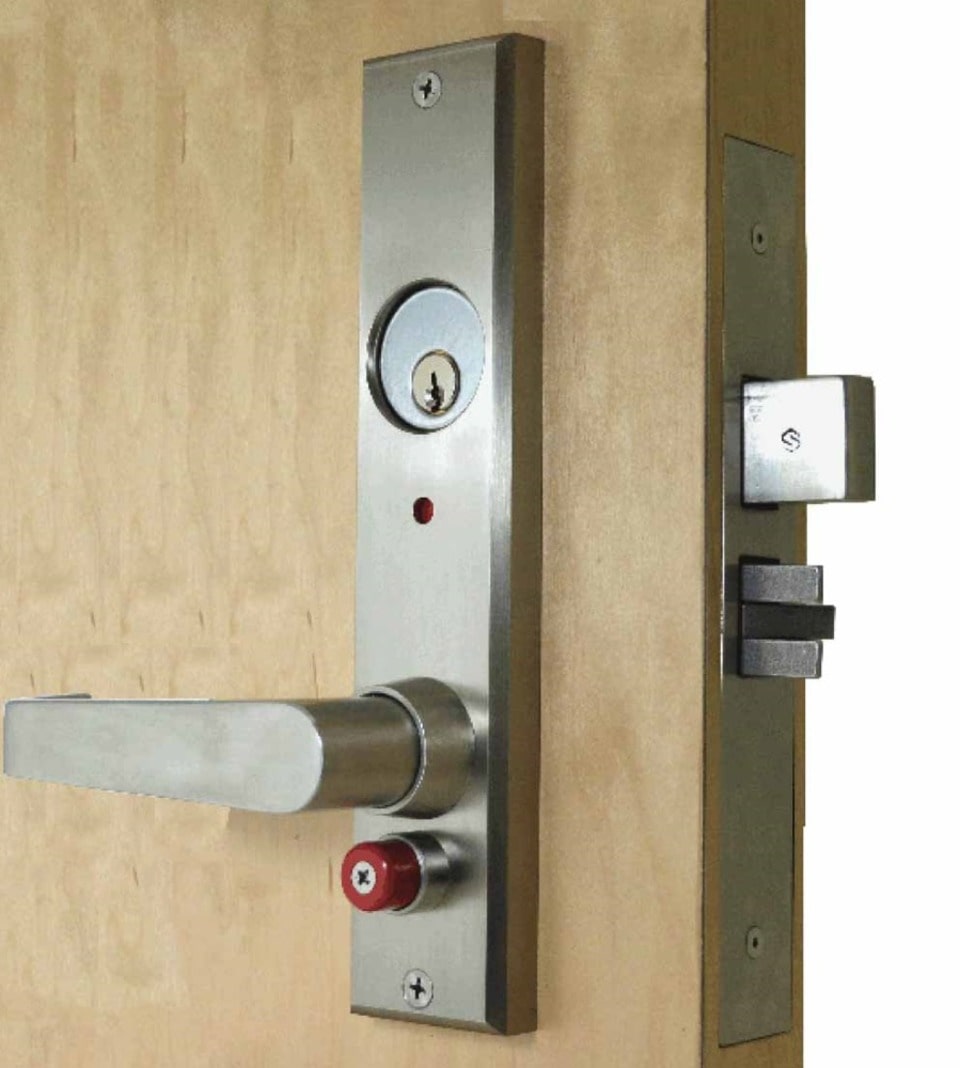
These retrofitted classroom locks come with improved visual indicators and are designed for doors that lock from the outside with a key. They can be locked from the inside quickly without needing a key, aligning with safety regulations and ensuring accessibility for those with disabilities.
Quick Activation: This lock features a convenient single-button push-to-lock system, enabling rapid engagement during emergencies when time is critical.
Subtle and Seamless: Crafted to integrate effortlessly into any learning or working environment, this lock maintains the focus of spaces such as schools, places of worship, or offices without being obtrusive.
Enhanced Security: Equipped with a vandal-resistant slip-clutch lever, this lock remains secure even if the door handle is compromised, offering strong defense against forced entry.
Regulatory Compliance and Accessibility: This lock adheres to all compliance and regulatory requirements, eliminating the need for rekeying while ensuring accessibility for individuals with disabilities. It offers:
– A single lever pull for easy interior exit
– An exterior key entry option for first responders and administrative personnel
Ideal for Classroom Lockdown Devices, this solution prioritizes safety and accessibility.
A Balanced Approach to School Security
Frequently Asked Questions About Classroom Door Lockdown Devices
What are classroom door lockdown devices?
Classroom door lockdown devices are hardware solutions that allow staff to secure a classroom door quickly from inside the room during an emergency, while preserving safe egress and code compliance.
What is the safest classroom door lockdown option?
In most cases, the safest option is a code-compliant classroom security (intruder/classroom) lock or a code-compliant electronic lockdown solution that maintains required egress and accessibility.
What is an intruder function (classroom security) lock?
An intruder function lock allows staff to lock the door from inside (typically using a key) without stepping into the hallway. It is commonly used as a compliant approach in K–12.
Are classroom door barricade devices legal?
Legality varies by jurisdiction, but many barricade devices raise compliance and safety concerns and may be rejected by local authorities. Always confirm with your local Authority Having Jurisdiction (AHJ).
Are classroom barricade devices code compliant?
Many are not, especially if they obstruct egress or require special knowledge/effort to disengage. Safety organizations and code professionals frequently flag these risks.
Do classroom door lockdown devices have to meet fire code?
Yes. Classroom doors and hardware must comply with applicable building and life safety codes and still allow occupants to evacuate quickly.
Do lockdown devices have to be ADA compliant?
Yes—hardware must be operable within accessibility requirements (for example, without tight grasping/pinching/twisting) and must not create barriers to egress.
Can first responders unlock the classroom door from the outside?
This is a major evaluation point. Some guidance warns that devices that prevent outside access can create safety and supervision risks.
Do barricade devices increase liability for schools?
They can. If a device compromises life safety, obstructs egress, or is not approved by the AHJ, it can increase legal and insurance exposure.
What is the difference between “lockdown” and “barricade”?
“Lockdown” typically refers to securing doors using compliant lock hardware or integrated systems. “Barricade” often refers to add-on devices that physically block the door—some of which may conflict with code requirements.
What should we ask vendors before buying a lockdown device?
Ask: Is it approved by AHJs in jurisdictions like ours?
Does it preserve required egress?
Can authorized staff/first responders access from outside?
Does it work on fire-rated doors without defeating the latch/closer?
Can we add a secondary locking device and still be compliant?
There have been code discussions/changes noted in the industry around secondary locking on existing K-12 classroom doors under specific conditions. This is jurisdiction-dependent—confirm locally.
Do magnetic latch covers or “quick fixes” violate code?
Some guidance warns that products that prevent the latch from functioning (or defeat fire-rated door performance) can create safety/code issues.
Are electronic lockdown systems better than mechanical locks?
Electronic systems can enable faster coordination (including remote lockdown) and auditing, but they must still meet life safety and accessibility requirements.
How much do classroom door lockdown devices cost?
Costs vary widely by solution type (mechanical vs electronic), door condition, and whether hardware is being retrofitted or replaced. Total cost often includes installation, training, and ongoing maintenance.
Can students operate classroom lockdown devices?
Most schools design procedures so authorized staff control lockdown actions. Policies vary, but schools typically avoid solutions that create misuse risks.
Do lockdown devices work on outward-swinging doors?
Some solutions do; others don’t. Door swing, existing hardware, fire rating, and frame condition determine compatibility.
Do we need to upgrade the whole school at once?
Not necessarily. Many schools phase upgrades—starting with highest-risk doors and standardizing hardware over time.
How do lockdown devices fit into school security systems?
Lockdown hardware secures the door. A complete school security system often includes access control, video, visitor management, and emergency communication (including panic alarms) for coordinated response.
Should a lockdown plan include school panic alarm systems?
Yes—many campuses use panic alarm systems for rapid notification while door hardware handles physical security and egress requirements.
A Balanced Approach to School Security
The safest classroom door lockdown solution:
-
Locks from inside
-
Maintains one-motion egress
-
Meets fire and ADA requirements
-
Integrates into a layered security plan
Door hardware is one part of a comprehensive strategy that should also include:
-
Visitor management
-
Access control
-
Staff training
-
Perimeter security
Classroom Lockdown Devices Within a Complete School Security System
Classroom door lockdown devices are one component of a comprehensive school security system.
An effective school security system typically includes:
-
Access control systems
-
Video surveillance
-
School panic alarm systems
-
Visitor management platforms
-
Intrusion detection
-
Code-compliant classroom door hardware
While lockdown devices secure individual rooms, a fully integrated school security system ensures communication, perimeter protection, and coordinated emergency response across campus.
School Panic Alarm Systems as Part of a Lockdown Strategy
Classroom door lockdown devices secure the physical entry point. However, effective emergency response also depends on rapid communication.
School panic alarm systems allow staff to instantly alert administrators or law enforcement during a threat. When integrated with door hardware and access control systems, panic alarms help initiate coordinated lockdown procedures in seconds.
For many districts, combining compliant classroom door lockdown devices with a centralized school panic alarm system creates a faster and more structured emergency response.
How Umbrella Security Helps Schools
Umbrella Security works with public and private schools to:
-
Evaluate existing classroom door hardware
-
Identify compliance risks
-
Recommend code-compliant lockdown upgrades
-
Implement integrated security systems
We prioritize safety without creating new liability risks.
The Best Classroom Door Lockdown Devices
This innovative lock technology consists of single-motion egress and key access, which allows the focus to remain on security and evacuating, rather than figuring out complicated mechanisms or forcing students to improvise by pushing desks and chairs to barricade the door. Its components consist of a stainless-steel emergency deadbolt, as well as a simple red button that can be easily and discreetly pushed to secure the classroom in case of an emergency. Along with that, the lock remains secure even if the door handle breaks off because of its vandal-resistant-slip-clutch-lever. These classroom door lockdown devices do not require network connectivity, electronics, or heavy wiring and can be installed on a door-by-door basis. However, it certainly can be access control equipped if that is what your facility desires. On its own, this classroom door lockdown device is more expensive than the previously mentioned (illegal) door barricades but is significantly less costly if you were comparing it to a complete access control system.
In the face of emergencies, schools must act swiftly to safeguard their occupants. Building-wide lockdowns need to happen quickly, and solutions must be able to deploy within seconds—as soon as a threat is perceived. Door locks alone are not enough, and an effective barricade is critical in keeping folks safe.
Luckily, retrofitted classroom door lockdown devices exist that are designed to enable all occupants, including those with disabilities, to quickly evacuate an educational facility during a fire, bomb threat, active shooter attack, and a variety of other evacuation situations.
The retrofitted classroom lock features an enhanced visual indicator and is designed for classroom doors locked by a key from the exterior; it can quickly lock down classroom doors from inside without using a key. This device falls in line with safety codes and can be operated by members of the handicapped community.
This innovative lock technology consists of single-motion egress and key access, which allows the focus to remain on security and evacuating, rather than figuring out complicated mechanisms or forcing students to improvise by pushing desks and chairs to barricade the door. Its components consist of a stainless-steel emergency deadbolt, as well as a simple red button that can be easily and discreetly pushed to secure the classroom in case of an emergency. Along with that, the lock remains secure even if the door handle breaks off because of its vandal-resistant-slip-clutch-lever. These classroom door lockdown devices do not require network connectivity, electronics, or heavy wiring and can be installed on a door-by-door basis. However, it certainly can be access control equipped if that is what your facility desires. On its own, this classroom door lockdown device is more expensive than the previously mentioned (illegal) door barricades but is significantly less costly if you were comparing it to a complete access control system.
By integrating these devices with a broader school-wide emergency strategy, institutions can ensure a comprehensive and efficient response. This multi-layered approach, combining individual classroom security with quick deployment systems, equips schools to better handle potential threats and maintain safety for everyone involved.
Exploring Other Classroom Door Security Devices
While the retrofitted classroom lock offers a sophisticated solution, other devices can also enhance classroom security:
1. Door Reinforcement Locks: These locks are installed into the door frame and use an arm mechanism to latch the door closed. They deploy from the inside and are easy to use. However, they might be dislodged easily, and drilling into the door frame could violate fire codes.
2. Door Chain Locks: Similar to reinforcement locks, these are installed on the door frame with a chain connecting to the door. They are simple to deploy but can be cut easily, and again, drilling could violate fire codes.
3. Floor Barricades: Mounted on a door, these use pressure against the floor to prevent opening. They are robust against force and simple to activate, but their strength depends on the floor and door structure. Fire code compliance is another concern.
4. Door Jammers: These devices are wedged between the door and floor to prevent forced openings. They are easy to install and quiet but only reinforce the bottom of the door, leaving other parts vulnerable.
5. Advanced Internal Locks: These locks, like the TeacherLock, allow only authorized individuals to lock from the inside and require a special key to unlock from the outside. They provide a discreet yet effective security solution without disturbing the classroom environment.
Door Barricade Devices for Classroom Lockdowns
A classroom lockdown device is the most cost-effective, retrofitted door barricade for existing doors to keep them compliant and safe. It is an excellent classroom lockdown solution that can easily be equipped onto the majority of existing doors. Educational facilities can lockdown classrooms instantly and with ease with this barricade lock, ultimately integrating the best way for their students, faculty, and staff to stay safe within their facility in an emergency. On top of all that, your facility will be avoiding the use of illegal classroom barricades.
By understanding the various options, schools can make informed decisions to enhance the safety and security of their classrooms, ensuring a swift and compliant response during emergencies.
What is the TeacherLock and What Are Its Features and Benefits for Classroom Door Security?
The TeacherLock system is an innovative internal door locking mechanism designed to enhance classroom security. It empowers teachers and designated staff members to secure their rooms quickly during emergencies without needing to step outside.
Key Features:
- Authorized Control: Only approved individuals inside the room can activate the lock, ensuring that the decision to secure the classroom remains with the responsible authority. The lock can only be opened from the outside using a specialized key, which can be distributed to other trusted personnel if necessary.
- Rapid Deployment: The locking mechanism is activated within seconds, providing swift security measures in urgent situations. This quick response time is facilitated by an ergonomic activator that allows efficient engagement without the need to kneel or bend.
- Durable Design: The locking system includes a robust bolting mechanism that guarantees reliability and longevity while maintaining a subtle presence to contribute to a calm classroom environment.
Benefits:
- Safety Compliance: The system adheres to important safety standards, such as the International Building Code, ADA, and NFPA Life Safety guidelines, ensuring that it is both effective and legally compliant.
- Cost-Effective Solution: It is designed to fit a variety of school budgets, making it accessible to different educational institutions looking to enhance security without overspending.
- Simple Installation: The lock can be easily installed on any door, eliminating the need for extensive modifications or complicated setups.
- Controlled Activation: The lock is ‘bullyproof’ because it requires a specific activator, keeping control firmly in the hands of authorized users. This contrasts with other locks that might be operated by students, ensuring that teachers maintain authority over classroom security.
- Emergency Accessibility: While providing interior security, the lock still allows outside access to emergency responders, balancing safety with crucial access for first responders.
This innovative locking solution provides peace of mind and practical security in classroom settings, ensuring that educators can focus on teaching while feeling assured about their safety measures.
Door Barricade Devices for Classroom Lockdowns
A classroom lockdown device is the most cost-effective, retrofitted door barricade for existing doors to keep them compliant and safe. It is an excellent classroom lockdown solution that can easily be equipped onto the majority of existing doors. Educational facilities can lockdown classrooms instantly and with ease with this barricade lock, ultimately integrating the best way for their students, faculty, and staff to stay safe within their facility in an emergency. On top of all that, your facility will be avoiding the use of illegal classroom barricades.
The Next Step for Safer Classrooms
Classroom Door Lockdown Devices are an essential part of school safety. They give teachers quick control, help students feel secure, and reassure parents that strong protection is in place. These devices are reliable, easy to use, and a smart investment for schools.
Lockdown hardware works best as part of layered school security systems — access control, cameras, and communication planned as one program.
By adding Classroom Door Lockdown Devices and pairing them with training and drills, schools create safer learning spaces. Take the next step today—administrators and parents should get in touch with Umbrella Security to learn more about installing Classroom Door Lockdown Devices and ensuring every child learns in a safe environment.
This article was updated on February 24th 2026, by Umbrella Security Systems.
Classroom Door Lockdown Solutions FAQ Sheet
Get a Free Copy of the 6 Page FAQ Sheet on Classroom Door Lockdown Devices. What Technology to use, avoid and what Security Professionals recommend.