
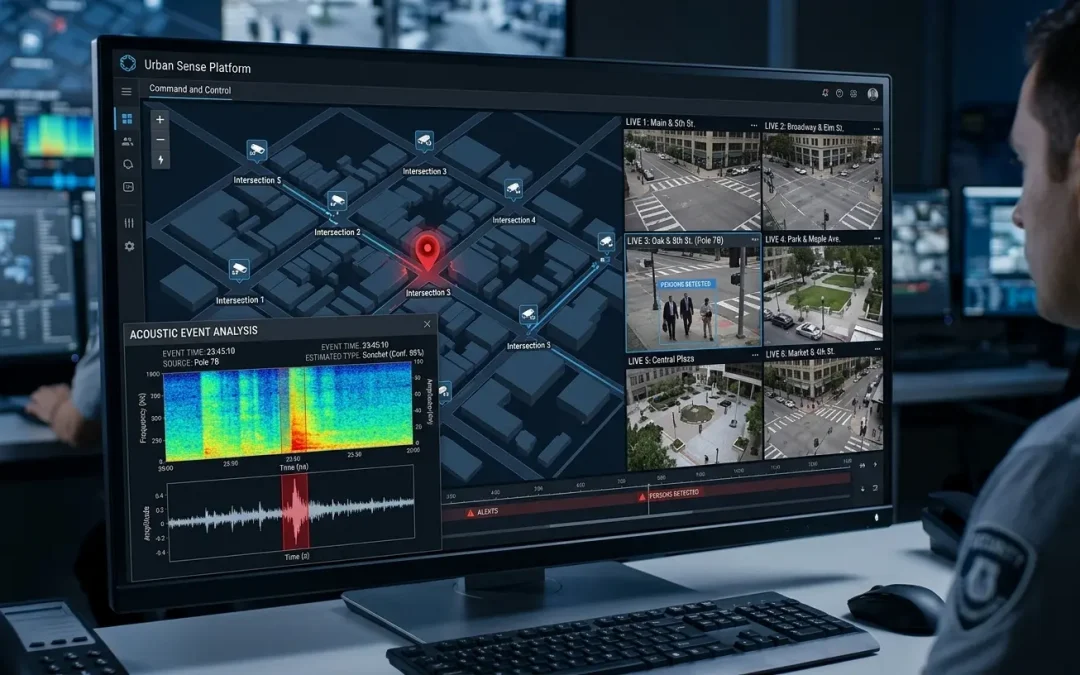

Types of Gunshot Detection Systems: Where They Fit and Why Facilities Use Them
Gunshot detection should not be treated like a magic shield. It does not stop a weapon from entering a building, replace emergency planning, or remove the need for trained people.
What it can do is important: gunshot detection can help shorten the time between a firearm discharge, situational awareness, internal response, camera verification, lockdown decisions, emergency notification, and first responder coordination.
This updated guide compares the types of gunshot detection systems, where they fit best, which vertical markets use them, and how they support a broader threat detection strategy.
For organizations comparing gunshot detection with entry screening, AI-based weapon detection, and broader threat detection planning, Umbrella’s weapons detection systems guide is the next step.
Quick Takeaways for Facility Leaders
| Question | Practical Answer |
|---|---|
| Is gunshot detection the same as weapons detection? | No. Gunshot detection identifies a firearm discharge after it happens. Weapons detection is focused on identifying weapons before they move deeper into a facility. |
| Who uses gunshot detection? | Schools, healthcare facilities, government buildings, commercial campuses, industrial sites, houses of worship, venues, parking areas, and outdoor public spaces. |
| What are the main types? | Acoustic, infrared/optical, shockwave-based, multi-sensor, indoor, outdoor, and camera-integrated systems. |
| What is the value? | Faster awareness, faster alerting, faster location information, better camera verification, and better response coordination. |
| What does it not solve? | It does not prevent weapon entry, replace emergency planning, eliminate false alarms, or remove the need for trained response. |
Gunshot Detection vs. Weapons Detection: Why the Difference Matters
A common planning mistake is treating gunshot detection systems and weapons detection systems like they solve the same problem. They do not.
Gunshot detection systems are primarily response-acceleration tools. They help identify that a firearm has been discharged and, depending on the system and environment, may help locate the event quickly.
Weapons detection systems are threat-screening tools. They are used to help identify firearms, knives, and other potential threats at entry points or within monitored environments before an incident moves deeper into a facility.
This blog should help you understand:
- The main types of gunshot detection systems
- Which facilities use them
- Why indoor and outdoor deployments are different
- How camera integration changes response
- Where gunshot detection fits in a layered safety plan
Use the pillar page when comparing:
- Weapons detection systems
- Entry screening
- Open-gate detection
- AI-based visual weapon detection
- Commercial threat detection strategy
Next step: weapons detection systems.
The Main Types of Gunshot Detection Systems
The best system depends on the facility, risk profile, noise environment, deployment area, budget, verification process, and emergency response workflow.
Umbrella field note
No detection system should be evaluated on marketing claims alone. Performance depends on the facility, sensor layout, noise profile, integration design, emergency procedures, and training.
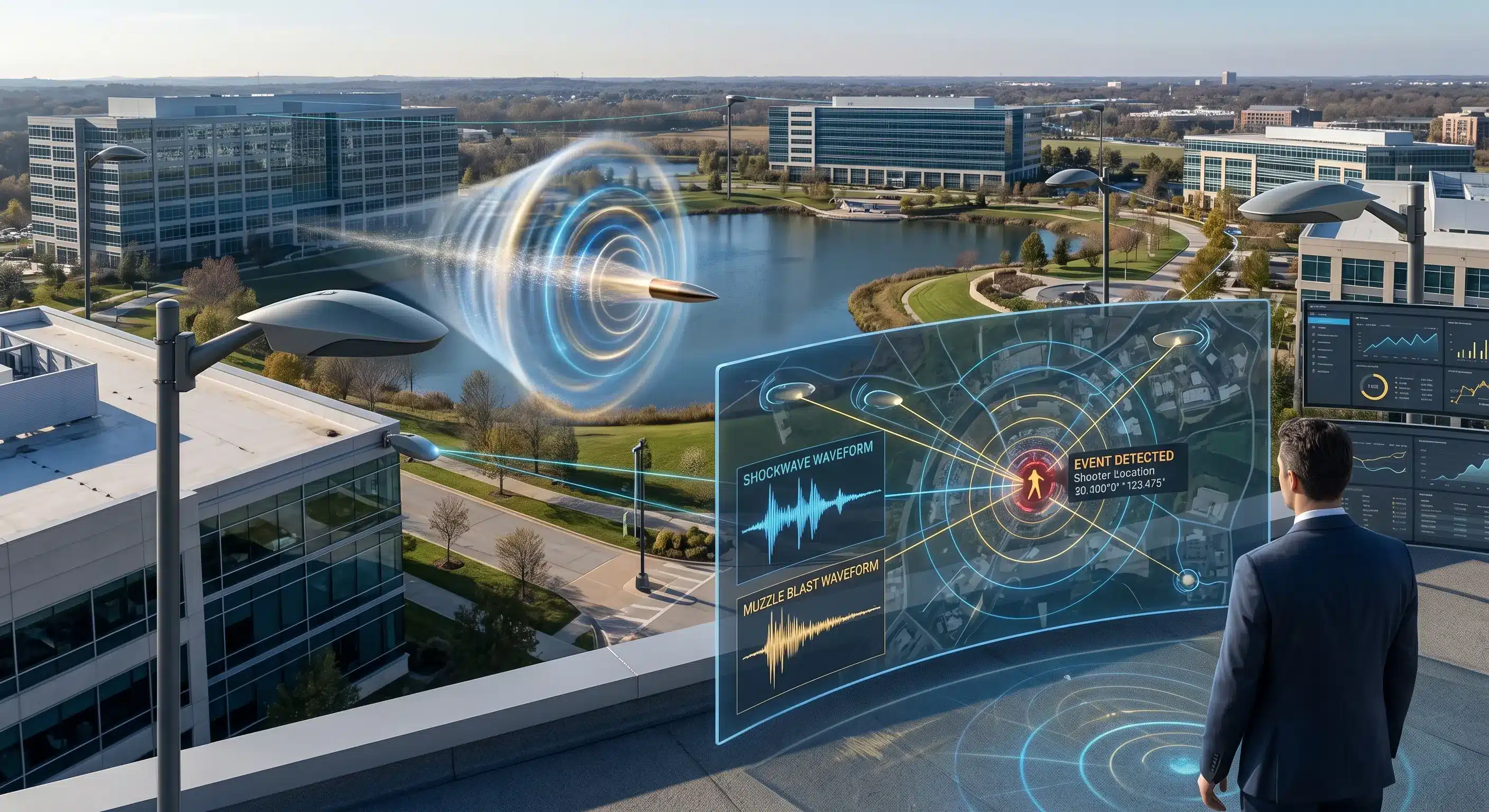
Acoustic Gunshot Detection
Uses sound sensors to identify acoustic signatures associated with firearm discharge. Often used in schools, campuses, offices, government buildings, and defined outdoor areas.
Infrared / Optical Detection
Looks for visual or thermal signatures such as muzzle flash or infrared energy. Useful where additional signal confirmation is needed.
Shockwave-Based Detection
May identify ballistic shockwave signatures, especially in outdoor, municipal, campus, critical infrastructure, or wide-area environments.
Multi-Sensor Detection
Combines signals such as acoustic and optical detection to improve alert confidence and reduce false-positive risk.
Camera-Integrated Detection
Connects detection alerts to nearby cameras so security teams can verify location, movement, and context faster.
Indoor and Outdoor Systems
Indoor systems account for rooms, hallways, and echoes. Outdoor systems account for weather, distance, public space, wind, and wide-area coverage.
Acoustic Gunshot Detection Systems
Acoustic gunshot detection uses sound sensors to identify the acoustic signature of a gunshot. Depending on the design, multiple sensors may compare timing, volume, and waveform characteristics to estimate location.
Best fit
- Schools and campuses
- Office buildings
- Municipal buildings
- Healthcare facilities
- Parking garages
- Urban outdoor areas
- Campuses with defined zones
Planning concerns
- Echoes and building materials
- Machinery noise
- Fireworks or backfires
- Construction noise
- Large open spaces
- Sensor spacing and calibration
Umbrella field view: acoustic detection should be evaluated based on the actual environment, not only a product brochure. A warehouse, school hallway, emergency department, parking garage, and outdoor courtyard behave very differently.
Infrared / Optical Gunshot Detection Systems
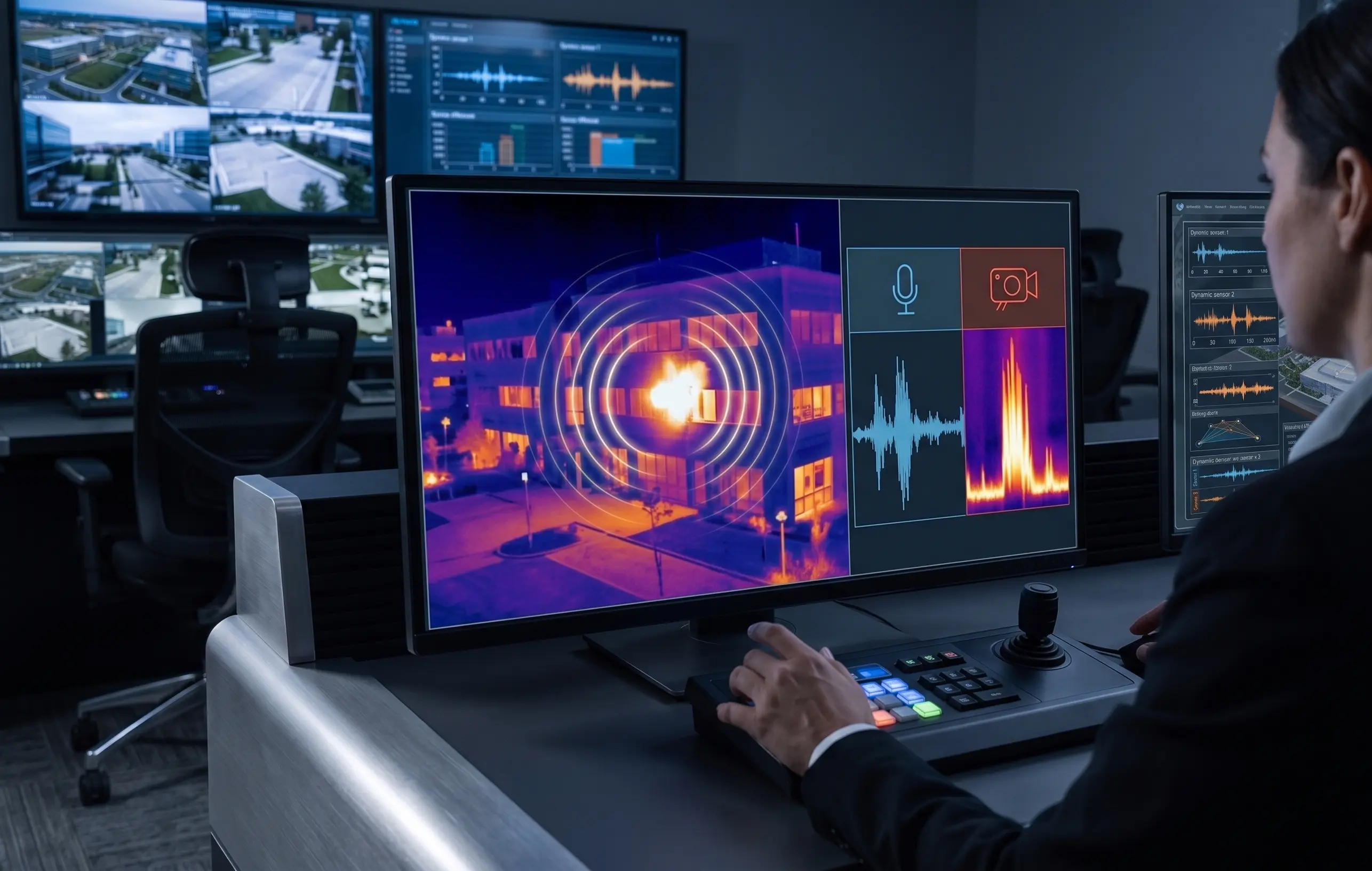
Infrared or optical gunshot detection systems look for visual or thermal signatures associated with firearm discharge, such as muzzle flash, infrared energy, or other light-based event patterns.
These systems are often considered when a facility wants an additional signal beyond sound. In some environments, sound alone may be too difficult to interpret because of echoes, machinery, construction, crowd noise, or other loud operational conditions.
High-consequence indoor areas
Useful where leaders want stronger signal confirmation in lobbies, corridors, public-facing spaces, emergency departments, and other sensitive zones.
Additional verification layer
A loud noise may not always be a gunshot. A light or thermal signature may provide another data point when designing the alert workflow.
Line-of-sight matters
Optical and infrared systems depend heavily on sensor placement, coverage angles, obstructions, lighting conditions, smoke, dust, and reflective surfaces.
Infrared or optical detection is rarely just a “mount sensors and move on” project. It should be planned around coverage zones, camera visibility, alert routing, and the organization’s emergency response plan.
Shockwave-Based Gunshot Detection Systems
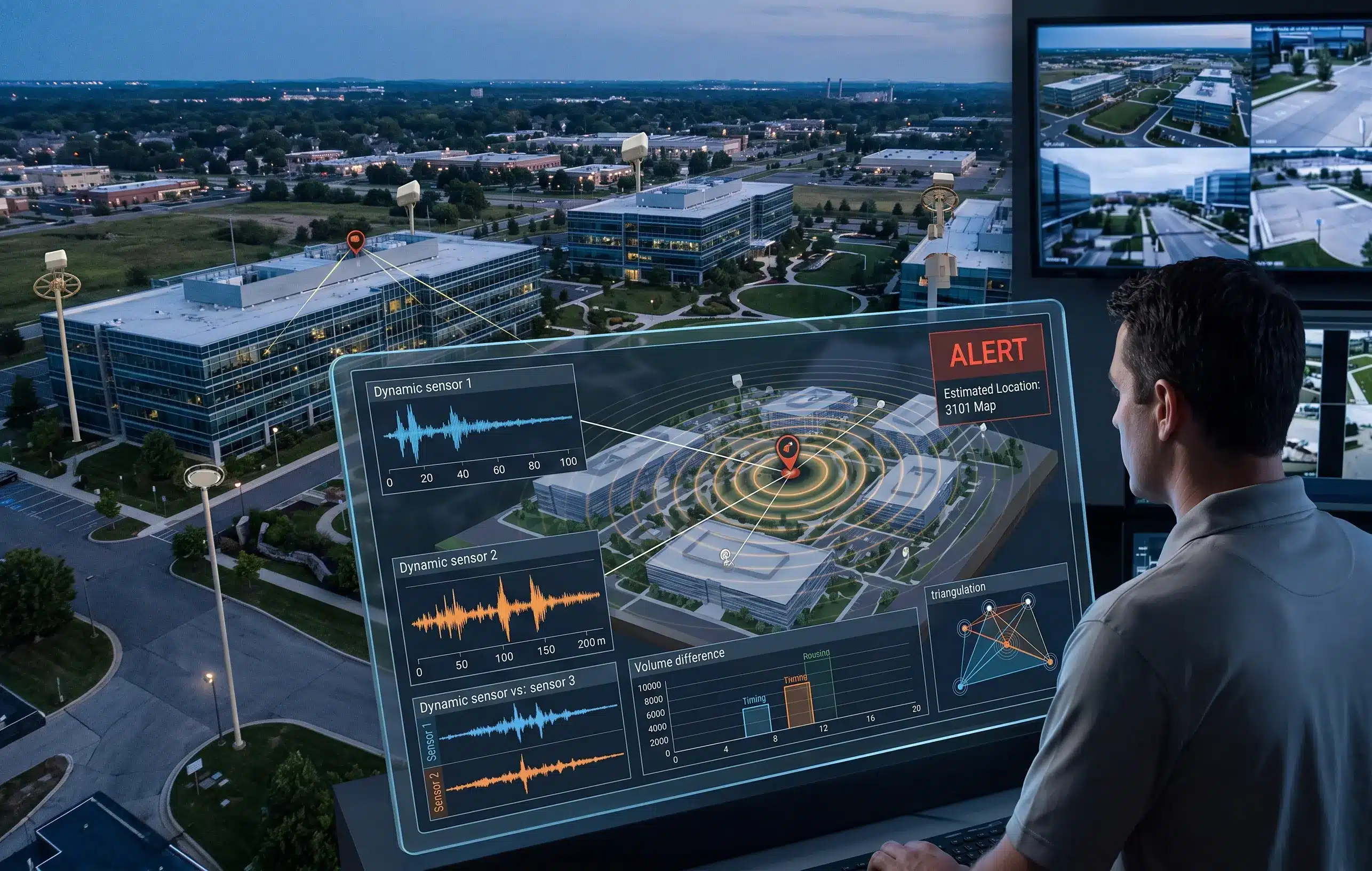
Shockwave-based gunshot detection systems may identify ballistic shockwave signatures, especially in outdoor or wide-area applications. A projectile traveling faster than the speed of sound can create a shockwave that specialized sensors may use as part of event detection or location estimation.
This type of detection is usually a more specialized planning conversation. It may be relevant for large outdoor spaces, critical infrastructure, municipal areas, industrial properties, or perimeter-sensitive environments.
Outdoor and wide-area sites
May fit municipal spaces, outdoor campuses, critical infrastructure, industrial yards, transit zones, and perimeter-sensitive properties.
Location awareness
When planned well, shockwave-related detection can support location estimation and faster situational awareness in outdoor environments.
Specialized deployment
Coverage depends on sensor placement, outdoor conditions, power, network availability, local noise profile, and response coordination.
Shockwave-based detection is not automatically the right fit for every facility. It should be evaluated against the site layout, response plan, law enforcement coordination, maintenance expectations, and how the alert will be verified.
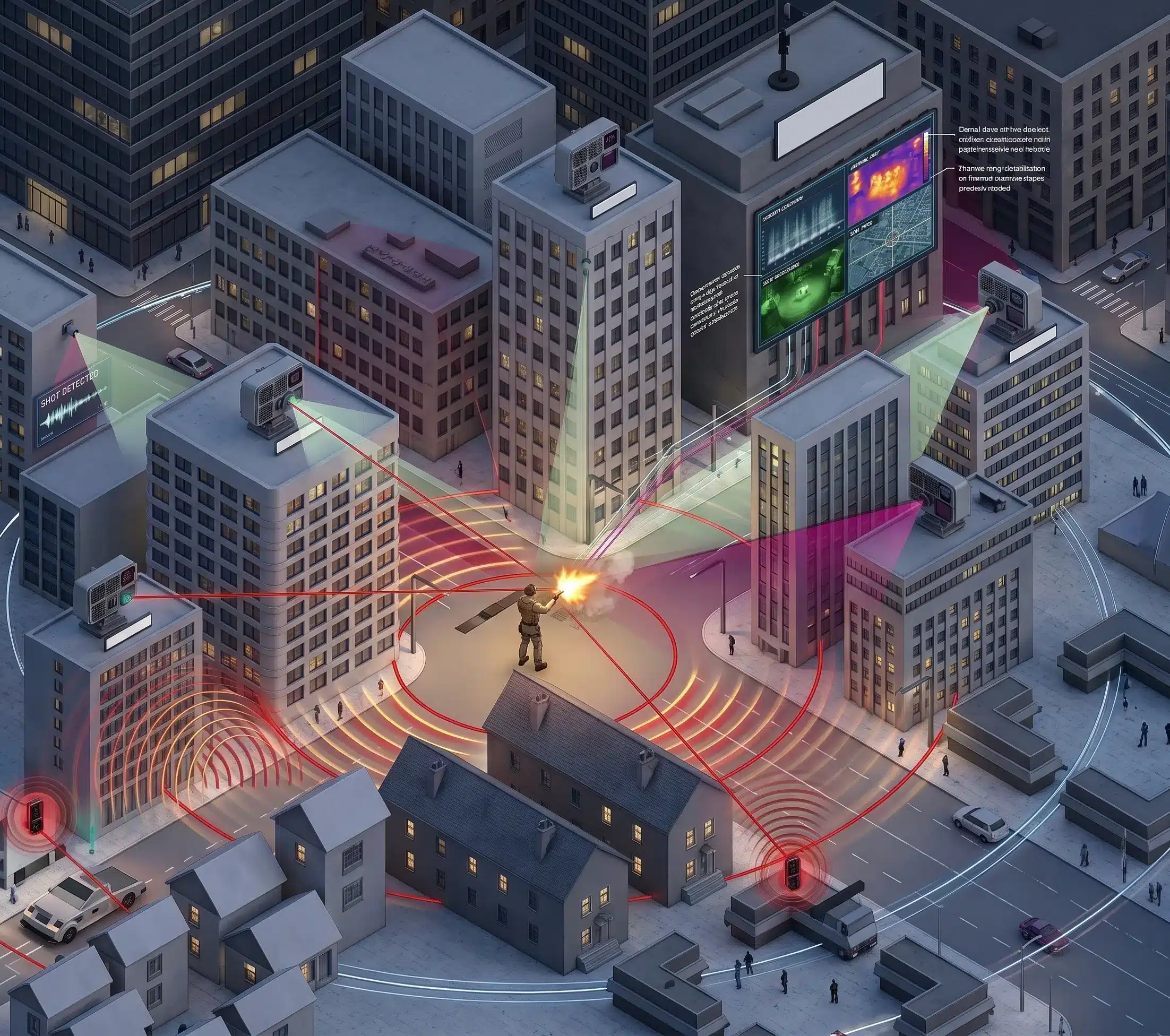
Outdoor Gunshot Detection Systems
Outdoor gunshot detection systems are designed for exterior areas, open spaces, campuses, parking lots, public spaces, and perimeter environments.
Best fit
- Parking lots
- Outdoor campuses
- Municipal spaces
- Stadiums and venues
- Courtyards
- Transit areas
- Industrial yards
- Critical infrastructure
Important reality
Outdoor gunshot detection is not just a technology decision. It is a coordination decision involving security, facilities, leadership, local law enforcement, and emergency communication planning.

Camera-Integrated Gunshot Detection Systems
Camera-integrated gunshot detection connects alerts to nearby security cameras. The goal is not just to know that a shot was detected. The goal is to help security teams and responders understand what is happening.

Verify faster
Nearby cameras can help security teams understand whether an alert requires immediate escalation.
Locate better
Camera views can help identify the affected area and surrounding movement after an alert.
Respond smarter
Security teams can coordinate doors, notifications, dispatch, and internal response with better context.
Related Umbrella resource: commercial security camera systems.
Which Vertical Markets Use Gunshot Detection Systems?
Different vertical markets use gunshot detection for different reasons. A school does not think like a hospital. A hospital does not think like a warehouse. A warehouse does not think like a city hall or house of worship.
Schools and Campuses
Schools may use gunshot detection to support faster lockdown awareness, emergency notification, camera verification, and first responder coordination.
Hospitals and Healthcare
Hospitals may consider gunshot detection for emergency departments, parking areas, public entrances, and large campus coordination.
Municipal Buildings
Government facilities may use detection for public-facing lobbies, council chambers, parking areas, courts, service counters, and police coordination.
Commercial Offices
Commercial facilities may use detection as part of workplace violence preparedness, tenant notification, access control coordination, and business continuity planning.
Industrial Facilities
Industrial sites need noise-aware planning because machinery, forklifts, loading docks, tools, and outdoor yards can complicate detection.
Houses of Worship and Venues
These environments need practical safety planning that protects people without making the facility feel like a fortress.
What Happens After a Gunshot Is Detected?
A gunshot detection alert is only useful if the organization knows what happens next. The right workflow should be planned before the sensors are installed.
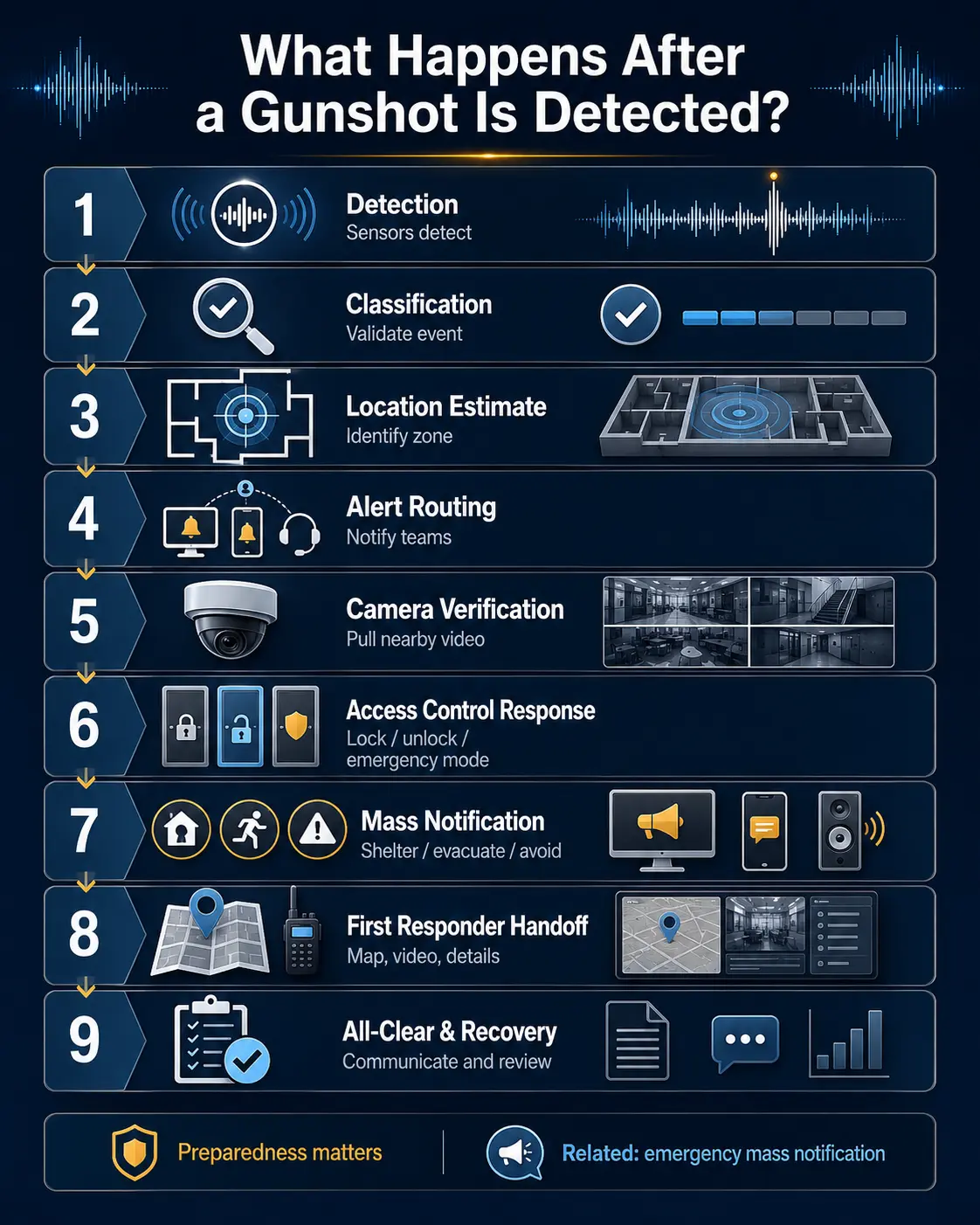
| Step | What Should Happen |
|---|---|
| Detection | Sensors identify a probable gunshot event. |
| Classification | The system evaluates whether the event matches expected gunshot signatures. |
| Location estimate | The system identifies the likely area or zone. |
| Alert routing | Security, administrators, dispatch, or monitoring personnel receive the alert. |
| Camera verification | Nearby cameras may be pulled up automatically or manually. |
| Access control response | Doors may be locked, unlocked, or placed into a defined emergency mode depending on the plan. |
| Emergency mass notification | Occupants may receive instructions to shelter, evacuate, avoid an area, or await further direction. |
| First responder handoff | Location, map, camera views, and incident details are communicated to responders. |
What Gunshot Detection Does Not Solve by Itself
This part matters. Gunshot detection is valuable, but it should not be oversold.
It does not automatically solve:
- Weapon entry prevention
- Visitor screening
- Poor camera coverage
- Untrained staff
- Confusing emergency communication
- Weak lockdown procedures
- Poor police coordination
- False-positive or false-negative risk
The right strategy is layered.
Gunshot detection supports response after a firearm discharge. Weapons detection systems support earlier threat identification. Cameras support verification. Access control supports containment and lockdown workflows. Emergency notification supports human instruction.
Gunshot Detection Planning Checklist by Facility Type

Schools and Campuses
- Which areas need coverage?
- Should alerts trigger lockdown workflows?
- Who receives the first alert?
- Can cameras verify the alert location?
- Has law enforcement reviewed the response workflow?
Healthcare Facilities
- Which departments have elevated risk?
- Should parking areas be covered?
- How are clinical teams notified?
- Which access-controlled doors change status?
- Who coordinates with law enforcement?
Commercial Properties
- Are tenants included in the notification plan?
- Who controls building-wide alerts?
- Are lobby and parking areas covered?
- How does after-hours response work?
- Can access control support lockdown?
Industrial Sites
- Is the environment too noisy for acoustic-only detection?
- Are exterior yards or loading docks included?
- How are shift workers notified?
- Are PA, radios, strobes, or mobile alerts needed?
- Who receives alerts after hours?
How Gunshot Detection Supports a Broader Weapons Detection Strategy
Gunshot detection belongs in the conversation, but it should not own the whole conversation.
A layered threat detection plan may include:
- Entry screening
- Open-gate weapons detection
- AI-based visual weapon detection
- Gunshot detection
- Security cameras
- Access control
- Visitor management
- Emergency mass notification
- Panic buttons
- Intercoms
- Staff training
- First responder coordination
For the full commercial evaluation of screening models, technologies, and threat detection strategy, use Umbrella’s weapons detection systems pillar page.
Frequently Asked Questions
What are the main types of gunshot detection systems?
The main types include acoustic gunshot detection, infrared or optical detection, shockwave-based detection, multi-sensor detection, camera-integrated detection, indoor systems, and outdoor systems.
Is gunshot detection the same as weapons detection?
No. Gunshot detection identifies and helps locate gunfire after a firearm discharge. Weapons detection systems are used to help identify firearms, knives, or other threats before they move deeper into a facility.
Which facilities use gunshot detection systems?
Schools, colleges, hospitals, government buildings, commercial offices, industrial facilities, houses of worship, event venues, parking areas, and outdoor public spaces may all consider gunshot detection depending on their risk profile and response plan.
Are indoor and outdoor gunshot detection systems different?
Yes. Indoor systems must account for hallways, rooms, echoes, and building materials. Outdoor systems must account for weather, wind, distance, fireworks, vehicle noise, and wide-area coverage.
Is acoustic gunshot detection reliable?
Acoustic detection can be useful, but reliability depends on the environment, sensor placement, system design, calibration, noise profile, and verification workflow. Buyers should avoid assuming performance without a site-specific assessment.
Can gunshot detection integrate with cameras?
Yes. Many deployments are more useful when gunshot detection alerts can pull up nearby cameras or guide security teams to the relevant area for verification.
Can gunshot detection trigger lockdowns?
Some systems can integrate with access control or emergency response workflows. Whether a lockdown should be automatic, manual, or verified first depends on the facility, risk tolerance, and emergency plan.
Does gunshot detection prevent shootings?
No. Gunshot detection does not prevent a weapon from entering a facility. It helps detect and respond after a firearm discharge. For earlier threat identification, organizations should evaluate weapons detection systems and broader security planning.
Build the Right Detection and Response Strategy
The right gunshot detection system depends on the facility. A school may need faster lockdown awareness. A hospital may need department-specific response. A city building may need public-area alerting. A commercial campus may need tenant communication. A manufacturer may need noise-aware detection planning.
Gunshot detection is best understood as a response-acceleration layer. It helps answer: Was there a gunshot? Where did it happen? Who needs to know? What cameras should we check? Which doors or areas matter? What instructions should people receive?
For broader planning around entry screening, AI weapon detection, open-gate systems, cameras, access control, and emergency response, start with Umbrella’s weapons detection systems guide.